
Micron Closes 2026 With $54.23B and Warns Memory Will Stay Tighter Through 2028

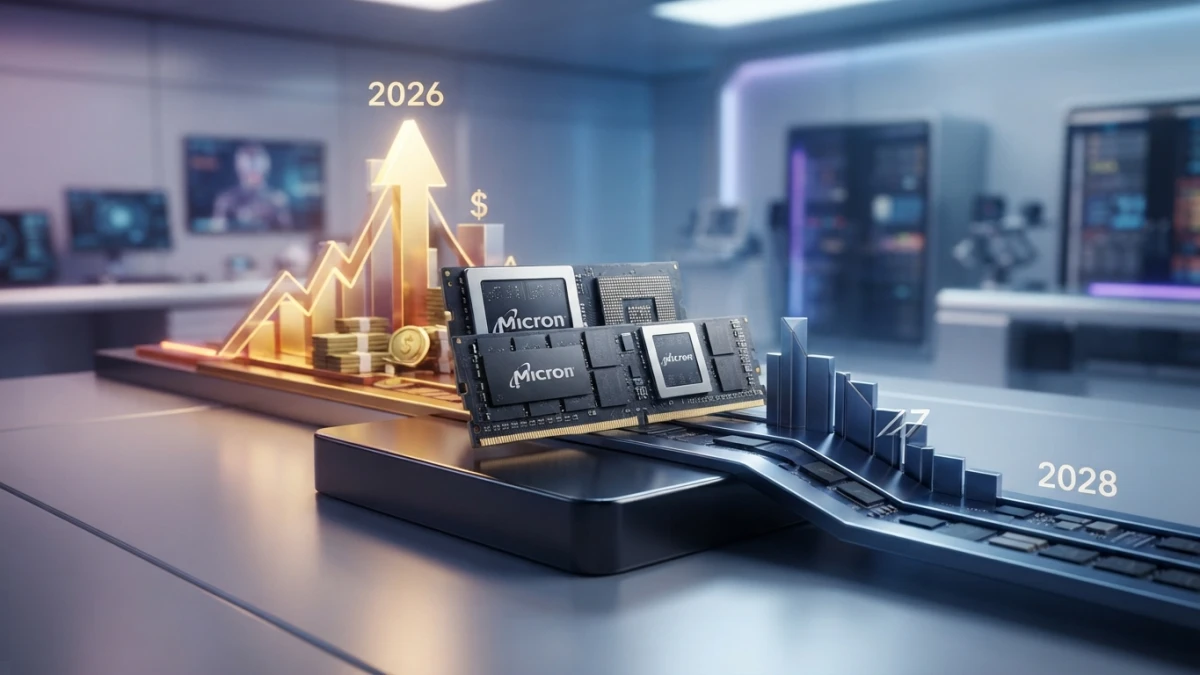
Micron closed its fiscal 2026 with $54.23 billion in a single quarter and warned that memory and storage supply will be "much tighter" in 2027 and 2028. Translation: the memory shortage is not going to fix itself.
What Happened on September 30: Micron's Numbers
On Wednesday, September 30, 2026, Micron reported results for its fiscal fourth quarter, which ended September 3. These are not ordinary numbers: they are the picture of a company that could not make as much as its customers wanted to buy.
A $54.23 Billion Quarter and a $133.2 Billion Fiscal Year
Quarterly revenue reached $54.23 billion, up from $41.46 billion in the prior quarter and $11.32 billion a year earlier, roughly a fourfold jump in twelve months. GAAP net income came in at $37.70 billion, or $32.87 per diluted share. For the full fiscal year, revenue totaled $133.2 billion, up 256% year over year and about 3.5 times the company's previous record.
Where the Growth Comes From: Data Center, DRAM and SSDs
Data center is the engine. Micron reported $18 billion from its Core Data Center unit, more than a tenfold year-over-year increase, with cloud and server storage pulling the weight. DRAM passed $100 billion for the year and data center SSDs approached $10 billion in the quarter alone. It is AI demand for memory and storage, not consumer demand, that is driving all of it.
Read also
The Forecast That Matters More Than the Results
For the next quarter Micron guided to $61.5 billion, give or take $1.5 billion, above what analysts expected. The company says it expects fiscal 2027 to be another record year, with sequential growth every quarter. That number, not the quarter already closed, is what moves the market.
Why the Market Shrugged
A record profit in a memory cycle also reads as a peak: if you have already sold almost everything you can make, where does the next jump come from? The stock moved little or lower after the announcement. It is the classic tension of the sector: the same numbers that explain the profit explain the price increases everyone else pays.
Why Memory Is Scarce and Why It Stays That Way Through 2028
On the earnings call, CEO Sanjay Mehrotra was blunt: memory and storage supply and demand conditions will be "much tighter" in 2027 and 2028 than in 2026. Read that as the company's forecast, not a done deal, but it fits everything else.
Read also

AI Eats the Fab: What HBM Is and Why It Swallows Capacity
HBM is memory stacked vertically and wired right next to the AI chip. It delivers far more bandwidth than conventional RAM, and it is the main reason fab capacity is so tight. Every gigabyte of HBM is more expensive to make than a gigabyte of DDR5 and uses the same production line: when demand for accelerators rises, more wafers go to HBM and less is left for the memory in your PC, phone and SSD.
How Contract Prices Moved in 2026
Early in 2026, conventional DRAM contract prices saw some of the biggest quarterly jumps in years, with high double-digit increases according to TrendForce, before moderating as the year went on. That pattern matters: it does not mean prices stop rising, it means the pace is normalizing at levels that are still high.
How Long a New Fab Takes
This is why the problem cannot be fixed with the push of a button. High prices should attract supply, but supply takes years: fabs, cleanrooms, lithography. Micron is saying it with numbers; most of its increased capital spending goes to construction, largely aimed at bringing cleanroom space online in late 2028 and beyond. That is what turns a price spike into a shortage with a calendar.
What Micron Already Sold and at What Price
The company said more than 75% of its 2027 supply is already committed to customers, and that most of its 2027 HBM was sold at significantly higher prices than a year earlier. Translated for buyers: this is not a one-quarter shortage, it is a long-term reservation with the price already agreed.
The Bill Other People Are Already Paying
Q4: DRAM Contract Prices and NAND
According to TrendForce, conventional DRAM contract prices are projected to rise 10-15% in the fourth quarter of 2026 and NAND Flash prices 15-20%, with enterprise SSDs the category that is accelerating on cloud provider demand.
PCs and Laptops: Memory Is Taking a Bigger Share
Memory has become a much larger part of a PC's component cost, and vendors have passed the increase to shelf prices: several brands raised laptop prices 15% to 30% in the first half of 2026, and Acer's CEO expects PC prices up to 20% higher by the end of the year, peaking around mid-2027. That is industry expectation, not certainty.
Phones, Consoles and SSDs
The same mechanism under a different label: mobile memory, consumer SSDs and console components rise because they compete for the capacity data centers are taking. Here it helps not to confuse contract prices (the deal between a maker and a large buyer, months in advance) with retail prices, which react later and carry the whole supply chain on top.
What to Do If You Write Code or Make 3D
Upgrade RAM Now or Wait
The simple rule: if your machine is short for your real work, compiling, containers, rendering, editing, upgrading now avoids paying more later. If you have headroom, buying memory "just in case" protects nothing and only brings the spending forward. A 3D artist moving from 32 GB to 64 GB for smoother work has a case; someone adding a kit they will not use does not.
VPS, Containers and CI
Plans with more memory are the first to be adjusted, because the provider buys DRAM on the same contracts that are rising. Before you renew, check instance size, reserved memory and disk cost: that is where the bill lands.
A 2027 Hardware Budget
If you buy equipment for 3D and rendering, budget for the increase instead of ignoring it. And do not overbuy memory you will not use: the goal is a machine that lasts, not one with more gigabytes than your workflow can take advantage of. If you come from 3D, the same dilemma shows up in Blender 5.3 and Gaussian Splats, where quality depends on the compute you can afford.
What Is Still Unknown
No one knows for sure when prices will fall. Micron expects tighter conditions in 2027 and 2028, its spending points to late 2028, and some sources think the peak comes around mid-2027. Those are estimates, not guaranteed dates. It is also unclear how much AI demand holds up if investment cools.
Conclusion
Micron closed a record year for the same reason your next machine will cost more: memory has become the bottleneck of AI, and that bottleneck does not widen in a single quarter. If you have to decide on a hardware or cloud purchase, decide with the numbers in hand, not the headline. We are still following this story on the blog: see how AMD is preparing its price increase and how Nvidia is booking compute at scale.