MediaTek's Dimensity 9600 Pro: The First 2nm Phone Chip Wants to Put AI in Your Pocket

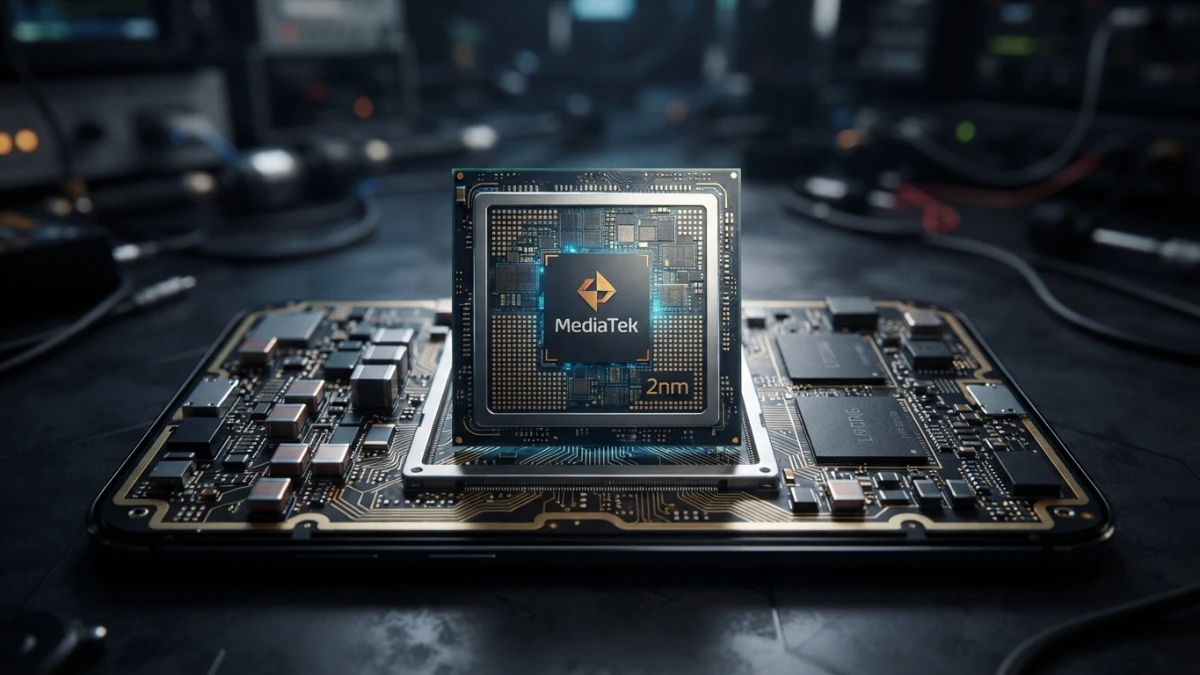
On September 15 MediaTek announced the Dimensity 9600 Pro, the first phone chip built on a 2nm process and the first to support LPDDR6. Its pitch: running 30-billion-parameter AI models inside the phone itself.
What the Dimensity 9600 Pro Is
It is MediaTek's first flagship SoC built on TSMC's 2nm node and the first phone chip on the market to declare support for both LPDDR6 and UFS 5.0. The company unveiled it from Hsinchu, Taiwan, next to the Dimensity 9600M, a variant for the standard high-end segment. Beyond the manufacturing process, it is still a chip for high-end Android phones: what changes is efficiency, not the operating system.
What the Jump to 2nm Really Means
A more advanced node fits more transistors into the same area, so performance can go up without spiking power draw, or stay flat while energy use drops. That is the real argument for 2nm, more than peak clock speed. Cost works against it: a 2nm wafer is more expensive, and that premium ends up in the phone's price.
MediaTek claims up to 61% less power than the previous generation, with 17% single-core and 15% multi-core gains. These are vendor figures, measured under conditions the company does not detail: useful as a reference, not as independent verification.
Read also

Dual NPU and 30B Models On-Device
The headline bet is a dual NPU design: a MediaTek NPU 1090 for the main workloads and a Super Efficient NPU 2.0 for low-power tasks. With that setup, MediaTek says the chip can run mixture-of-experts (MoE) models of up to 30 billion parameters locally, while supporting Gemini Nano and offline agents.
MoE models fit for a simple reason: each query activates only a fraction of the parameters, so results are produced without moving the whole model through memory. That is what makes a large model viable on a device that cannot spend a server's watts. The vendor's AI numbers are 40% faster token generation and 27% faster model launch.
LPDDR6 and UFS 5.0: Why Memory Matters More Than Clock Speed
LPDDR6 is pitched as roughly a third faster than LPDDR5X, and UFS 5.0 as twice as fast as the previous standard. For on-device AI that is no marketing footnote: model weights must load from storage and fit in memory, so the bottleneck usually sits there rather than in the cores. The CPU uses Arm's C2 architecture with eight cores and 34.5 MB of cache, alongside a new GPU that MediaTek reports as up to 27% faster.

Performance Numbers, With Context
An engineering platform running the chip scored 4,216 single-core and 12,765 multi-core in Geekbench 6, according to specialist outlets: between 18% and 21% above the same platform with the Dimensity 9500.
Read that carefully. The slides comparing it to Apple's A20 Pro are circulating through the press and are not an official benchmark, and in them the Dimensity 9500 score is lowered by 8.5% to inflate the generational gain. That is marketing material: a vendor figure is not an independent measurement.
The Uncomfortable Context: Scarce Memory and Pricier Phones
The launch lands in the middle of a memory crunch. Mobile DRAM prices rose between 78% and 83% in the second quarter of 2026 because AI data center demand is absorbing high-end production, and memory went from 10-15% to 30-40% of a phone's bill of materials. MediaTek is pitching this chip as the one that reduces memory use during a shortage, while analysts expect double-digit price increases for phones and PCs.
Conclusion
The Dimensity 9600 Pro is better understood as the first serious step toward AI that lives in your pocket than as a scoreboard fight. Qualcomm answers at its Snapdragon Summit from September 22 to 24 with the Snapdragon 8 Elite Gen 6, and the first phones with this chip are expected in the fourth quarter in the Vivo X500 and OPPO Find X10 lines, according to the press, not the vendors.
To follow the silicon and AI thread, there is my breakdown of Nvidia's N1 SoC and the GB10, the recap of Made by Google 2026 and the Tensor G6 and the AI chip battle.