Anthropic Signs $11.6 Billion With Akamai: Why AI Needs CPUs Too

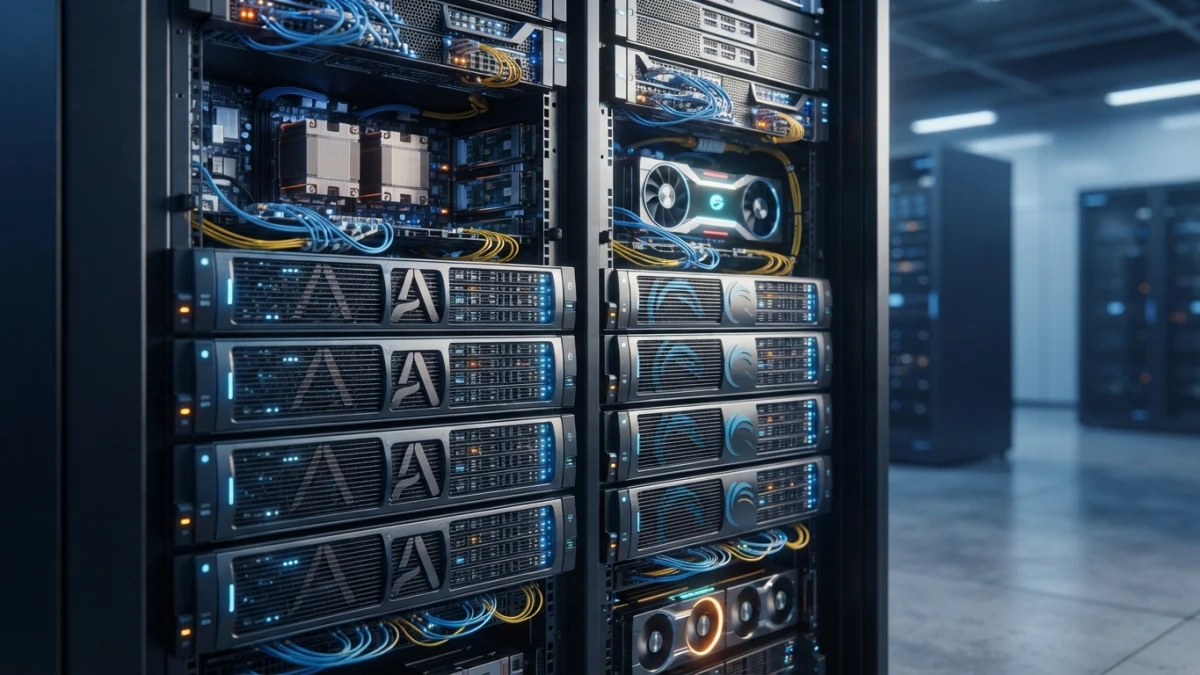
On September 24 Akamai announced that Anthropic has committed $11.6 billion to it over seven years, and the detail that matters is not the number but the word attached to it: CPUs. Not a GPU purchase for training models: general-purpose capacity for the work agents do outside the model.
What Was Signed on September 24
Akamai Technologies (NASDAQ: AKAM) described the move as a "significantly expanded" relationship with Anthropic: $11.6 billion in contractual commitments over seven years to support the AI company's growing CPU workloads on Akamai Cloud's distributed infrastructure and software. Training GPUs are not mentioned anywhere in the announcement, and that absence is the news.
The Contract Numbers: $11.6 Billion Over Seven Years, Up to $9 Billion More
Do not mix up three different figures. The $11.6 billion is the contracted commitment. The relationship can expand by up to an additional $9 billion within the same seven-year term. The potential ceiling then adds up to roughly $20 billion. These are contractual commitments, not revenue already booked: what gets signed today is consumed over the coming years.
The Warrant: Up to 5% of Akamai, With a Slice Vesting Now
Akamai issued Anthropic a warrant for non-voting convertible Series B preferred stock: 7.7 million shares of common stock on an as-converted basis, equivalent to about 5% of shares outstanding, at an exercise price of $111.33 per share. A slice representing roughly 2% of the company vests with the initial $11.6 billion commitment, while the remaining 3% vests as the relationship expands. In plain terms: vendor and customer stop being just that and become seven-year partners.
Read also

How the Market Reacted
Akamai shares rose around 20% in after-hours trading on Thursday, with press reports ranging from 16% to 26% depending on the source and the moment of measurement. This is market information, not a recommendation. The company also said it expects no impact on its 2026 revenue guidance and anticipates an increase of about $1.7 billion in this year's capital spending to secure and pre-purchase critical supply chain components, memory included.
Why an AI Bill Gets Paid in CPUs
The short analogy: the GPU is the engine that generates tokens and the CPU is the factory around that engine, the one ordering parts, assembling, moving, storing and billing. If you only look at price per token, that factory is invisible.
What the GPU Does in an Agent and What the CPU Does
Generating tokens is GPU work: the model computes and returns text. The rest of an agent's turn is CPU work: spinning up and controlling the isolated environment where the code the model just wrote runs, calling tools, retrieving and ranking information, reading and writing caches, routing requests and preprocessing or postprocessing results. That second slice does not scale with the size of the model; it scales with the number of steps the agent takes.

Running Code, Calling Tools and Caching: the Work You Never See
Adding a new tool to an agent does not make generation more expensive; it fattens the CPU side. The same happens when you add steps, run more execution environments in parallel or cache responses to cut latency. That is how a company with a very large network of general-purpose servers becomes a compute provider for an AI lab without selling a single GPU.
The CPU Demand the Industry Projects for 2030
A market analysis cited by industry press estimates that agents could add between $32.5 billion and $60 billion to the CPU market by 2030, and describes architectures in which CPUs and GPUs are deployed separately. That is a third-party projection, not data from Anthropic or Akamai, and it should be read as such.
What Anthropic Is Buying From Akamai (and What It Isn't)
Akamai Cloud and Its AI Grid: 4,400 Locations to Move Inference Closer
In March 2026 Akamai launched AI Grid, an orchestration layer for distributed inference across more than 4,400 locations on its network, routing workloads between edge, regional and core tiers based on latency, cost and performance. This is the piece that explains why an AI lab buys here: it is not just about owning machines, but about having them where the work is.
About $5.5 Billion in Estimated Capital Spending and No Change to 2026 Guidance
Akamai estimates roughly $5.5 billion in capital expenditures tied to the commitment. The deal adds to more than $2.8 billion in multi-year cloud infrastructure services commitments the company had already announced this year, a sign that Akamai's business is shifting from serving content to moving compute.
The Unknowns: How Much Capacity, When It Arrives and Under What Terms
The contract does not break down how much capacity is reserved, in which locations, on what schedule or with what penalties. There is no unit pricing either. This is the fine print that usually decides whether a deal like this gets delivered or renegotiated.
The Deal on Anthropic's Compute Map
GPUs for the Model, CPUs for Everything Else: SpaceX, Azure and Google in One Sentence
Anthropic keeps buying GPUs elsewhere: capacity at SpaceX's Colossus 1 data center, with more than 300 MW and more than 220,000 NVIDIA GPUs, plus commitments with Microsoft Azure and TPU capacity on Google Cloud. The Akamai deal replaces none of that; it adds the CPU tier that never existed at this scale.
What the Announcement Does Not Say
It does not say GPUs are surplus, it does not say inference gets cheaper and it does not say when the capacity comes online. Any headline claiming one of those three things is adding what the release did not put there.
What It Changes If You Write Code
Lower Latency Through Proximity, and More Non-GPU Work on the Bill
If general-purpose capacity is spread across thousands of locations near users, the first things to improve are the parts of your flow that were already CPU work: code execution, queries, caching and response formatting. Token generation latency barely moves, because that depends on where the GPUs are.
Where to Run the Code Your Agent Generates
The practical decision is the usual one, with one more argument behind it: run model-generated code in an environment that is close, isolated and has clear resource limits. The closer to the user and the cheaper per task, the better the math works out, and that is exactly the part of the stack these contracts reinforce.
Signals to Watch: Price per Token and Compute Contracts
Two thermometers tell you where the real cost of AI is heading. Price per million tokens, which already moved with the price war of recent months, and compute contracts like this one, which anticipate where the bottleneck sits before it shows up on your bill.
Conclusion
The easy headline is that Anthropic signed yet another giant compute deal. The useful headline is that part of the AI bill gets paid in CPUs rather than GPUs, and that changes where it makes sense to run things. Worth reading next: the Anthropic vs OpenAI price war, Alibaba's own chips and AMD's price increase.
Sources: Akamai's press release, RTTNews, the Akamai AI Grid announcement and Anthropic on Colossus 1.