
Meta Connect 2026: $349 Camera-Free Glasses, the Muse Charm Gadget and $1,300 VR Glasses

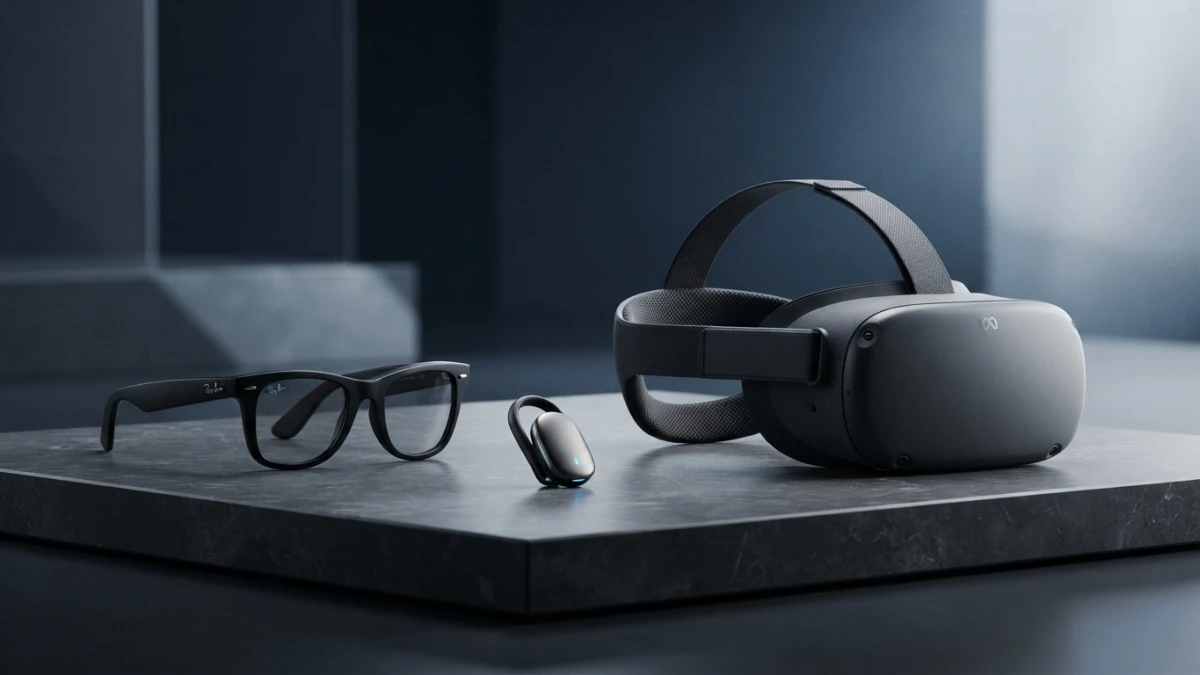
On September 23 Meta unveiled four devices and one idea, personal superintelligence, and the most debatable one is the quietest: $349 Ray-Bans with no camera that still record audio without warning anyone.
What Meta Announced at Connect 2026
The event ran on September 23 and 24 in Menlo Park, with Mark Zuckerberg's keynote on Wednesday afternoon and developer sessions the next day. What came off the stage was a full consumer range, with Muse, the personal assistant, as the thread running through it.
Ray-Ban Meta Audio: No Camera, 43 Grams and $349 From October 13
These are Meta's first glasses without a camera. They keep the audio and assistant features and drop image and video capture. Meta highlights the 43-gram weight, lighter than the camera models, and battery life of around 12 hours against 9 hours on the previous generation. They can be pre-ordered from $349 and ship on October 13. The reasoning is plain: Meta wants a product that does not carry the camera-glasses label.
Ray-Ban Meta (Gen 3) and Meta Adventurer: $449 Down to $249
The third generation of the camera-equipped Ray-Bans is available since the same September 23, priced from $449, with around 9 hours of battery, a 12-megapixel camera and 3K video. At the cheap end, the Meta Adventurer lands at $249 in a basic version with a black frame and grey lenses, on sale October 23. The line drops its price floor just as the Quest headsets remain the expensive item in the catalogue.
Read also


The Shift: Less Metaverse, More Personal Superintelligence
Coverage of the keynote agrees on one point: the metaverse was diluted into one feature among many while the talk revolved around personal superintelligence, with AI agents and devices you wear instead of carry in your pocket. That is a journalistic reading of the event, not a line from a press release, but it explains why almost everything announced points back to the assistant.
Muse, the Assistant Meta Wants Everywhere
What Muse Is and Why It Launched on September 8, Before the Event
Muse is Meta's personal agent, launched on September 8 in the United States for iOS, Android, the web and WhatsApp, running on the Muse Spark 1.3 model. It does more than answer: it opens the browser, fills in forms and runs tasks on its own. It has a free tier with a weekly token cap and paid plans. At Connect, Meta said it will stay free for now and will reach more countries with new shopping partnerships.
Muse Charm: A Pocket Device With a Screen and a Fingerprint Sensor, No Price
The Charm is a pocket device with a screen and a fingerprint sensor, meant for talking to Muse without wearing the glasses. You set it up from the Muse app, and two units can recognise each other when brought close. Zuckerberg said it will arrive before the December holidays, and no price was announced. Nor was availability outside the United States confirmed: today it is an announced product, not one you can buy.
Muse Makes You Money: The Business Behind a Free Assistant That Takes a Cut
The interesting part is not the hardware, it is the business model. Meta said that over time it will make money by charging a small commission per transaction rather than a subscription. That is why the assistant wants to be everywhere: the more it buys and books for you, the more often it takes its cut. It also explains the standoff with Amazon, which blocked Muse on its store after the app shot to the top of the App Store.
The Uncomfortable Question: No Camera, No Warning
The Vendor's Argument: No Image, No Problem
Meta presents the Ray-Ban Meta Audio as an answer to the discomfort camera glasses create. The logic is simple: with no image, there is nothing to object to. Coverage reported that the product exists partly to shed the label that camera glasses carry around.
What Does Not Change: The Microphone Records and Nothing Lights Up
The detail worth saying out loud is about design, not an accusation: the camera-free glasses still capture audio, and unlike the camera models, which light up while recording, there is no visible warning for the person next to you. Less capture capability is not less capture: it changes what is captured, not whether it is. Compared with Snap Specs, which bet on full augmented reality at $2,195, these are opposite philosophies: discretion and a low price against capability and a high one.
Meta VR Glasses: 100 Grams, No Strap, $1,300
What Is Inside: Micro-OLED, the Compute Puck and Two Sizes
This is Meta's first bet on virtual reality in glasses form, with no strap. The part on your face weighs about 100 grams, roughly a fifth of the Quest 3's 515 grams. They use high-density micro-OLED panels with pancake lenses and come in two sizes. The processor, storage and battery live in a tethered compute puck of about 300 grams, running Qualcomm's Snapdragon chip. To picture it: the glasses are the window and the puck is the engine; splitting them is what takes you from 500 grams down to 100 without the device heating up on your face.
What You Can Do With Them and When They Ship
They promise several virtual windows in the air and mirroring a Mac or PC display, with IMAX Enhanced certification, the first on a VR device according to the coverage. The price is around $1,300 and shipping is planned for spring 2027. They are not the successor to the Quest 3: this is a new, lighter product, and Meta retired no headset line at the event. Competition is coming the same way, with Google's Project Aura alongside Xreal.
What to Buy and What to Wait For
Confirmed Prices and Dates Versus What Meta Did Not Say
Confirmed: Ray-Ban Meta Audio from $349 on October 13, Ray-Ban Meta Gen 3 from $449 available now, Meta Adventurer from $249 on October 23 and Meta VR Glasses at around $1,300 in spring 2027. What Meta did not say: how much the Muse Charm will cost, when it will reach countries outside the United States and whether Muse support will be available on every device from day one.
What to Check Before Buying Smart Glasses in 2026
Three questions settle almost any decision. First, what you want the device to do: if the answer is audio, hands-free and assistant, the $349 rung makes sense; if it is capturing photos and video, it does not. Second, where you will use it and how the people you record feel about it. Third, whether the price you see is final or a launch price. This article compares prices and features, it does not recommend buying: that call is the reader's.
Conclusion
Connect 2026 was not the metaverse event, it was the assistant event: Meta put Muse at the centre and built four doorways around it, from $249 to $1,300. The most interesting product is not the most powerful one but the quietest, and that is also its weak spot. What remains to be seen is the Charm's price and whether the assistant holds up to scrutiny when it records without anyone noticing.
The blog has covered the rest of the 2026 board: Snap's $2,195 Specs, the local model Muse Glimmer and Meta's earlier smart glasses.