Anthropic and OpenAI Halve Their Prices on the Same Day: Opus 5.5 vs GPT-6 Sol and Luna

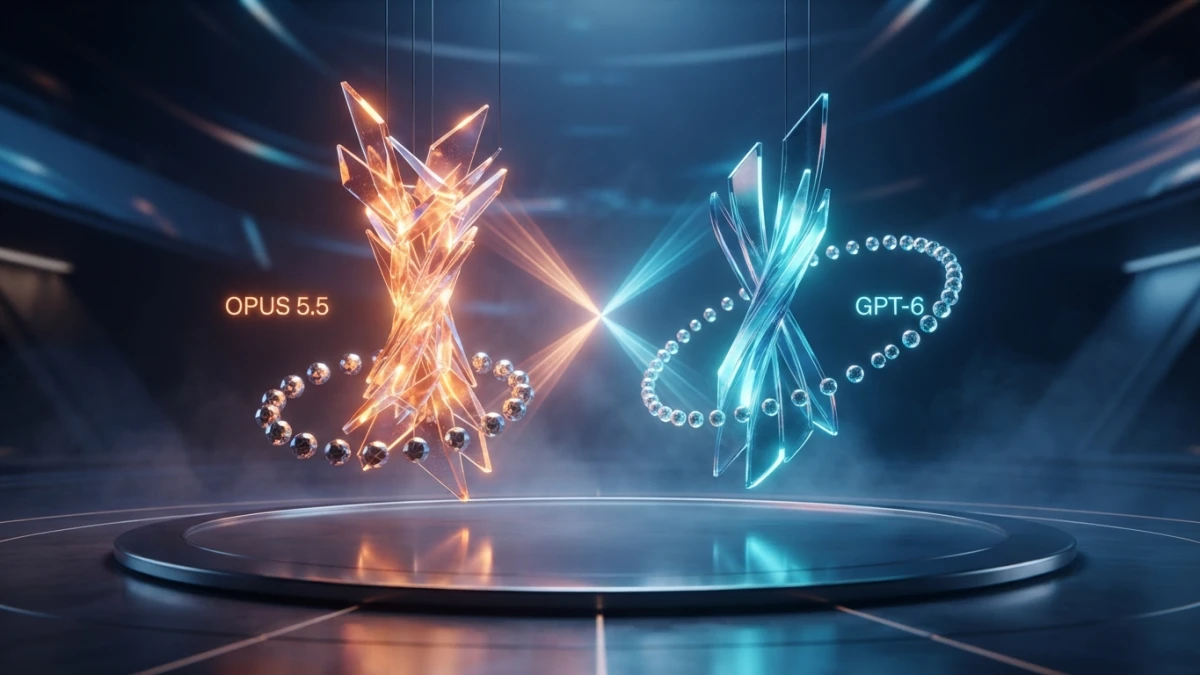
On September 22 Anthropic released Claude Opus 5.5 at $4 and $20 per million tokens and OpenAI answered about 90 minutes later with GPT-6 Sol and GPT-6 Luna: the price of AI dropped, and what you actually pay depends on the fine print.
What Was Announced on September 22
Both launches landed the same day, a little over an hour apart. Anthropic published Claude Opus 5.5 and, roughly 90 minutes later, OpenAI published two GPT-6 models priced below it. This was not the usual capability duel: what changes the daily life of anyone paying for API calls was the price per million tokens.
Claude Opus 5.5 and the Opus Price Cut
Opus 5.5 is the first model in the Claude 5.5 family. Anthropic says it performs at the level of Claude Fable 5.1 across most work while costing roughly 40 percent less to run than Opus 5. It brings a one-million-token context window, up to 128,000 output tokens, multimodal input and a June 2026 knowledge cutoff. It is available in the Claude apps, in Claude Code and through the API. The company also said Sonnet 5.5 and Haiku 5.5 will arrive in the coming weeks: that is a plan, not a product you can use today.
The price cut is the hard number: Opus moves from $5 and $25 per million input and output tokens to $4 and $20. Cache reads drop from $0.50 to $0.20. Anthropic also says output is more than 30 percent faster, and that one is worth taking as a vendor figure.
Read also


GPT-6 Sol and GPT-6 Luna, 90 Minutes Later
OpenAI answered with two models trained with methods similar to GPT-6 Astra, the top of its family. Sol is the demanding-work tier for code and agents; Luna is the fast, cheap one. The company pitches them as frontier intelligence for everyday work and is rolling them out in ChatGPT Work, Codex and the API, with Batch, Flex, Fast and regional processing options. Astra remains the most capable model in the house: Sol and Luna do not beat it, they simply lower the price for work that does not need the ceiling.
List Prices, Side by Side
Compared in dollars per million input and output tokens:
- Claude Opus 5.5: $4 and $20. Opus 5 used to cost $5 and $25.
- GPT-6 Sol: $2 and $10, half its GPT-5.6 equivalent.
- GPT-6 Luna: $0.10 and $0.50, also half.
Between Luna and Opus 5.5 there are two orders of magnitude of difference on input: $0.10 against $4. Read that way, the price war headline holds up.
Read also

The Benchmarks, With a Source for Every Number
Artificial Analysis: Opus 5.5 at 58, Astra and Fable 5.1 at 53, Sol at 48 and Luna at 37
On the Artificial Analysis Intelligence Index, an independent measurement, Opus 5.5 reaches 58 points at maximum effort, ahead of GPT-6 Astra and Claude Fable 5.1, both at 53. Sol lands near 48 and Luna at 37. It is the highest score that index has recorded, but it is still one specific index and not a verdict on which model fits your work.
The Vendor's 66.4 Percent Versus the Independent 59.6 Percent
This is the clearest example of why the source matters. Anthropic publishes 66.4 percent for Opus 5.5 on Terminal-Bench 4.0. An independent run cited in the coverage puts it at 59.6 percent, level with GPT-6 Astra instead of ahead of it. Neither number is false: the test depends on who runs it, with which configuration and how much reasoning effort. On the vendor table, Opus 5.5 also scores 52.5 percent on CursorBench at medium effort, against 51.8 for Fable 5.1 at maximum effort. Same goes for the marketing lines: Fable 5.1-level performance for less is a company claim, not a replicated result.
Why Both Labs Cut Prices at the Same Time
Chinese Open-Weight Models and Customers Moving to Production
The explanation the business press keeps repeating has two legs. The first is pressure from open-weight models, Chinese ones above all, which set the reference price per token and force closed labs to defend their margin. The second is market maturity: many customers that were running pilots have moved to high-volume deployments, where price per token matters more than a spot on a leaderboard.
Pacing the Frontier Does Not Mean Raising Prices
The contrast that day is hard to miss. Anthropic shipped Opus 5.5 and described it as its first release since it called for pacing the frontier, and it did so by cutting prices and competing head-on. That is a real tension the coverage flagged: the same industry warning about risks is pushing prices down to win share. For API buyers the practical outcome is good; for the deeper debate, it leaves the question open.
The Fine Print That Decides Your Bill
The Long-Context Tier: Above 272,000 Tokens the Whole Request Changes
GPT-6 Sol supports a 1,050,000-token window, with roughly 922,000 maximum input and 128,000 output. The trap is the tier: under OpenAI's terms, a request with more than 272,000 input tokens moves to the long-context tier, where input and cache reads bill at double and output at 1.5 times, applied to the entire request rather than just the excess. Anthropic charges the same per-token rate across its full one-million window. If you send long documents or a growing agent history, that difference can outweigh the list price.
Cache Reads and Promotional Prices With an Expiration Date
Real agents spend most of their money re-reading context: history, tools and documents that come back on every turn. That is why cache reads move the bill more than anything, and why Anthropic's cut from $0.50 to $0.20 matters more than it looks. On the OpenAI side, some coverage describes the rate as promotional with a deadline while the vendor page presents it as list pricing: if you are building a budget on these numbers, confirm the price in force on the day you decide instead of assuming it holds.
How to Pick a Model Without Wasting Money
Cost per Task, Not per Token
Price per token is not cost. The cost of a task is input tokens times their rate plus output tokens times theirs, and in an agent the accumulated input weighs more than the final answer. The useful analogy: you do not pay the same for every page read as for every page written, and re-reading the same file is cheaper once it is cached. Measuring one real task from your own product tells you more than any comparison table.
Effort Levels and Mixing Models
The same model can cost twice as much depending on configuration: reasoning effort and verbosity multiply tokens without changing the task. The recipe that follows is to mix: an expensive model to plan and break down the problem, a cheap one to execute the mechanical steps. With Luna at $0.10 input, paying Opus rates for the repetitive part makes little sense.
What It Changes If You Write Code
Model IDs, SDKs and the Migration Path
Migrating means changing the model identifier and reviewing two or three parameters, not rewriting the application. On OpenAI the models are available as gpt-6-sol and gpt-6-luna in Responses and Chat Completions; on Anthropic the model comes through its usual API and Claude Code. Before moving production, test with your own traffic and compare a real week of billing, because cache and long-context rates change the result depending on your usage pattern.
What to Watch: Sonnet 5.5 and Haiku 5.5, and Promo-Price Lock-In
Three things are still open. First, the small models in the 5.5 family, announced for the coming weeks: those are usually the ones production products actually run. Second, the quality no leaderboard captures, such as behaviour on long tasks or resistance to malformed instructions. And third, the risk of tying your architecture to a launch price that expires.
Conclusion
On September 22 the price of AI was halved at the two labs that set the market, and that is good news for anyone paying the bill. But the real saving depends on the context you carry, the cache and the billing tier, not on the headline. Measuring cost per task with your own traffic remains the only way to know whether the switch is worth it.
The blog has been following the pulse of open-weight models and pricing: DeepSeek V4.1-Flash, Alibaba's Qwen3.8-27B and OpenAI's disclosure framework are the context from this same week.