US Charges California CEO With Smuggling $300M in Nvidia Servers to China

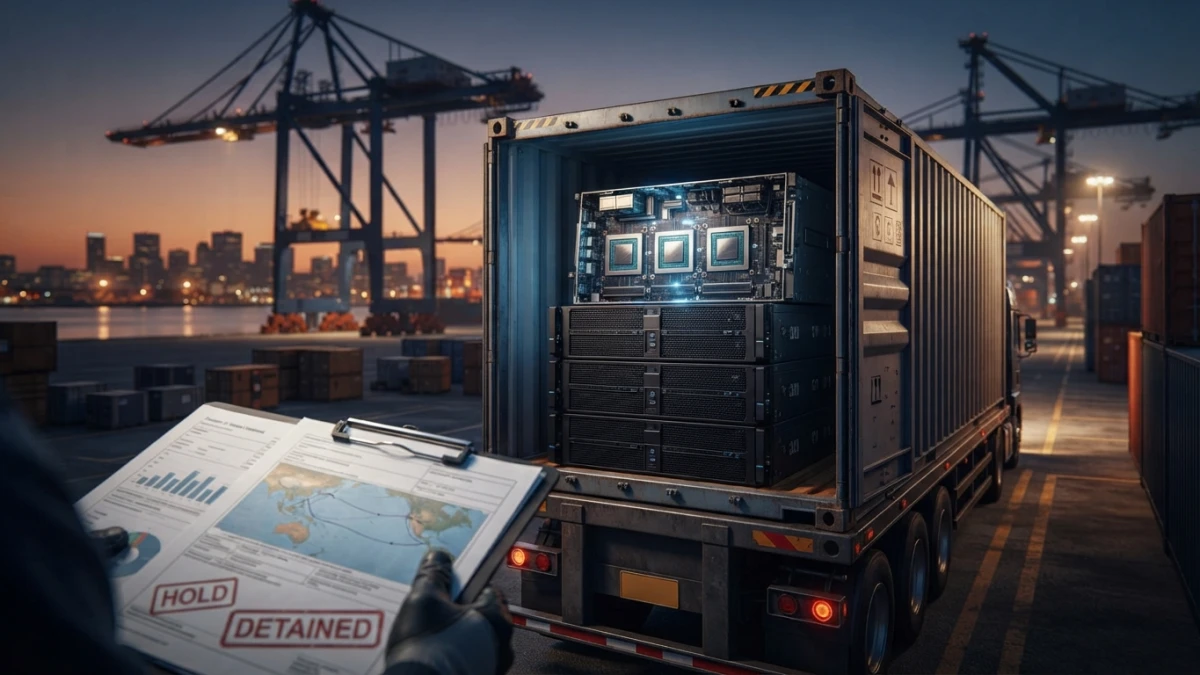
A California tech executive was arrested on October 1, accused of exporting more than $300 million in servers with restricted Nvidia chips to China. It is an indictment, and it explains why the lock on Nvidia chip smuggling is not the hardware but the paperwork.
What Happened on October 1, 2026
Greg Lui, Owner of Earthmade Computer, Arrested in California
The U.S. Department of Justice announced the arrest of Greg Lui, 38, also known as Yiu Kong Lui and a resident of San Gabriel, California, the owner of Earthmade Computer. The arrest took place on Thursday, October 1, 2026, and the indictment was filed in the Central District of California.
Three Counts
The indictment lists three federal counts:
- Conspiracy to violate export controls.
- Outbound smuggling.
- Conspiracy to launder money.
If convicted, the statutory maximums stack: up to 20 years on the export-control conspiracy, up to 20 on the money-laundering count and up to 10 on the smuggling count. Those are maximums, not a sentence.
Read also


The Number: More Than $300 Million
The case centers on servers with export-controlled Nvidia chips worth more than $300 million. Prosecutors allege that Earthmade received more than $176 million from two Malaysia-based shipping firms between January and October 2024.
Presumption of Innocence: What Is Established and What Is Only an Allegation
This is a charge, not a verdict. The prosecution is presenting its case and nothing is proven until a jury decides; Lui is presumed innocent. One important clarification: Nvidia is not accused of anything in this case.
What Prosecutors Allege
Malaysia and Singapore as Stops, China as the Final Destination
According to the indictment, the servers were first shipped to Malaysia and Singapore, where the same license is not required, and from there re-shipped to China. Prosecutors allege that no license was ever sought for any of the destinations.

False Paperwork and End-User Certificates
The core of the case is not hidden boxes but papers: invoices and end-user certificates that described a destination other than the real one. That element is what turns a shipment into a crime.
How Investigators Trace a Single Server
The indictment does not work with an aggregate number but with individual machines identified and tracked along the route. In export cases, the serial number and the destination document are the trail that lets investigators reconstruct where a specific machine went.
How Chip Export Controls Work (Without the Jargon)
What an Export License Is and What the BIS Does
In the United States, the Bureau of Industry and Security (BIS) at the Department of Commerce administers export controls. If a product lands on the controlled list, shipping it out of the country to certain destinations requires a prior license.
What Makes a Chip "Controlled"
It is not a list of model numbers: it is thresholds of capability. The BIS classifies advanced chips by total processing performance, performance density and interconnect bandwidth. If a chip clears those thresholds, it falls into a controlled category (ECCN 3A090 for advanced computing, for instance) and its export to China is subject to a license. The controls date back to 2022 and were broadened in 2023.
End User and End Destination: Why Paperwork Is the Real Lock
What is controlled is not just the box leaving the warehouse, but where it goes and for whom. That is why a scheme like the one described in the indictment does not need to hide hardware: it only needs to manufacture a credible destination.
Presumption of Denial
For the most advanced AI chips headed to China, policy applies a presumption of denial: the license, in practice, is not granted. That is why the control gets evaded by lying about the destination rather than by asking for permission.
Why Nvidia Chip Smuggling Runs Through Paperwork, Not Hardware
The Legal First Leg and the Illegal Re-Export
Malaysia and Singapore are not subject to the same restriction, so the first shipment can be perfectly legal. The crime shows up in the second leg, when the same server leaves again for China. That is why the indictment leans on documents and shipping firms rather than hidden cargo.
Who Signs the End-User Certificate
The end-user certificate is a statement about who will use the equipment and for what. Signing it falsely is not an administrative slip: it is a criminal matter, and the liability falls on resellers, integrators and cloud providers too, not only on the manufacturer.
Where Enforcement Is Looking: Transit Hubs, Intermediaries and Freight Forwarders
Authorities have focused on transit countries and logistics firms, not only on the final seller. In a supply chain, enforcement extends to the intermediaries that certify the destination.
This Case Isn't Alone: the 2026 Pattern
Taiwan and the B300 Servers
In August 2026, prosecutors in Keelung, Taiwan, indicted nine people over the illegal export of 74 servers with Nvidia B300 chips to China, according to coverage of the case. That is external context, with its own date and its own sources.
The BIS, Freight Forwarders and Shell Entities
The BIS has turned its attention to logistics companies and to shell entities in Singapore, not just the seller. The signal is that enforcement no longer treats this as isolated transactions but as a chain that must be watched end to end.
What Bloomberg Asked About Nvidia
On October 1, Bloomberg reported that officials are asking why Nvidia did not catch red flags in chip diversion cases. That is a supervisory question from the press, not a charge: Nvidia is not accused in this case.
Remote Access: the Legal Route That Also Bypasses Physical Controls
Beyond physical shipping, there is the option of renting capacity with restricted chips outside China and accessing it remotely. It is a legal route authorities watch closely because it sidesteps the hardware control without moving a single box.
What This Means for You
Why Top-End GPUs Are Expensive and Scarce
The tighter the control, the fewer chips enter the available market: longer wait lists and higher prices, both for hardware buyers and for those renting cloud capacity, much like the memory shortage dragging on the sector.
If You Resell, Integrate or Host Hardware
The end-user certificate and the declared destination are your responsibility. Forging documents carries criminal consequences; when in doubt, not exporting and checking the applicable rules is far cheaper than a prosecution. Competition in the legal market is fierce: the same Nvidia living through this case just expanded its share buyback and signed multi-billion contracts with AI customers.
If You Rent Cloud Capacity
Access to restricted chips has its own rules, and regulatory pressure moves fast. Manufacturers are already reshaping their compute offerings to comply, as shown by the shift toward inference chips running on CPUs and toward local alternatives aiming to route around the controls.
What Comes Next
If new developments appear — bail, additional formal charges, a response from the companies named — this post stands by what is known on its publication date. In an open case, the only reliable version is what is on the record, and no facts are getting ahead of it.
Conclusion
The Greg Lui case is an indictment and should be read as one. But it leaves a useful idea even for anyone who will never export anything: in AI hardware, the real control is not in the box, it is in the paper that says who owns it and where it is going. Keep reading the blog for the next pieces on chips, prices and regulation.