Huawei Pulls Ascend 960DT Forward to Q1 2027: The Bet Isn't a Faster Chip, It's a Much Bigger Machine

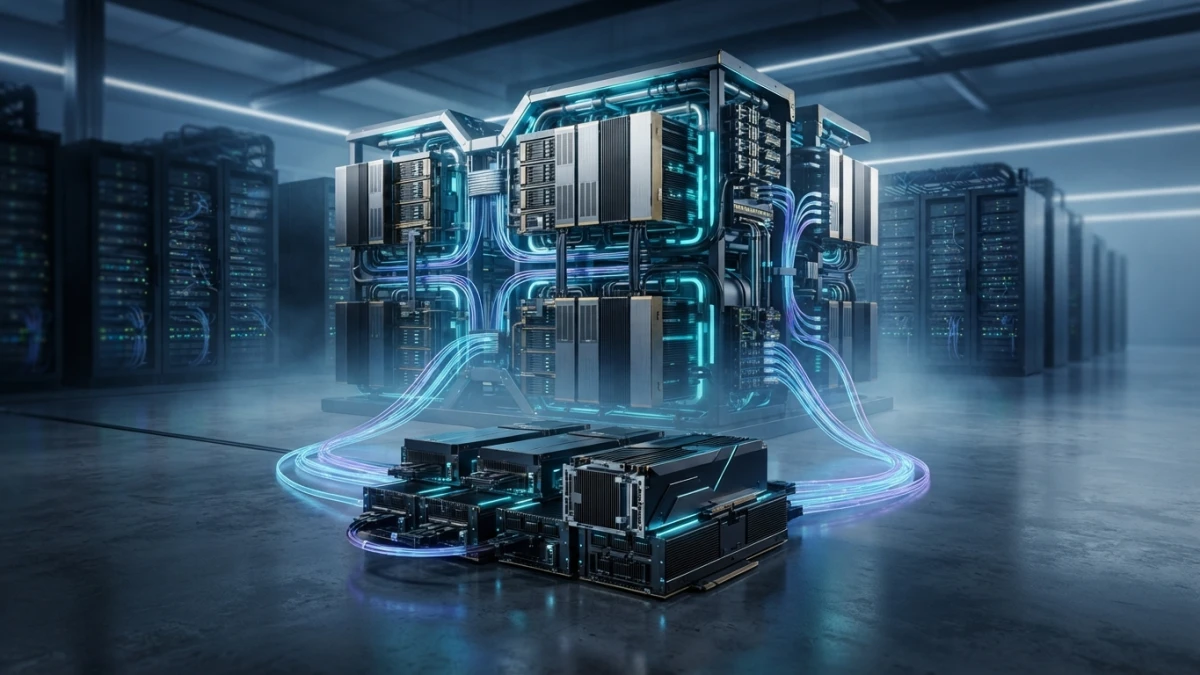
Huawei pulled its Ascend 960DT AI chip forward by two quarters, to Q1 2027, at the same event where it unveiled Peerium, an architecture meant to tie up to a million processors into one system. The news is not the chip: it is how the chips are wired together.
What Huawei Announced at Connect 2026
At HUAWEI CONNECT 2026, held in Shanghai on September 17, the company announced three things that are worth separating: a calendar change, an interconnect architecture and a full system. All three carry the same caveat: for now their only source is the vendor itself.
A Chip That Arrives Early: From Q3 2027 to Q1 2027
The Ascend 960DT had been scheduled for the third quarter of 2027 and moves to the first. International coverage described the move as roughly nine months earlier, and the detail matters more than it looks: pulling an accelerator forward is not just about having the design ready, but about wafers, packaging and memory being available. Moving a date forward says something about the supply chain, not only about the roadmap.
Peerium: A Million Processors Acting as One Computer
Peerium is the centrepiece. It combines the company's UnifiedBus interconnect with nested parallelism and unified memory addressing, and its stated goal is to let groups of up to a million processors work as a single machine for AI workloads. Put plainly: if the problem is that thousands of chips do not talk to each other well enough, the answer is not a faster chip but a better network.
Read also
The SuperPoD With Packaged Optics and the Hi-ONE Optical Engine
Alongside it came the SuperPoD from the 960 family, with optics packaged close to the chip (NPO, near-packaged optics) and a proprietary optical engine, Hi-ONE, which Huawei presents as the industry's first of its kind with an integrated light source. Event coverage places it at around 4,096 accelerators and about 8 exaflops in FP8, with optical links in the order of 7.2 Tbps, aimed at models approaching 10 trillion parameters.
The Core Idea: Scale by System, Not by Chip
For years the conversation was about how many FLOPS your accelerator has. In training, that number stopped being the real limit long ago: what holds back a large cluster is interconnect and memory bandwidth. An accelerator waiting on data delivers less than its spec sheet, and past a certain size every millisecond of latency between nodes gets multiplied by thousands.
Interconnect and Memory: The Real Bottlenecks
That is why the industry now competes on the whole system: the rack, the network, the optics and the power needed to move data between thousands of accelerators. Packaged optics exist for exactly this reason: integrating the optical links next to the chip cuts modules, power and complexity, which is the part that explodes as a cluster grows.
The Parallel With Nvidia
It is the same move Nvidia made with NVLink and its rack-scale strategy: when the silicon looks similar, the advantage gets built in how it connects. Reading this announcement as Huawei has caught Nvidia misses the interesting part; reading it as Huawei repeating Nvidia's playbook with its own plumbing explains what was actually presented far better.
The Numbers That Were Actually Published
- Ascend 960DT, per event coverage: in the order of 2 PFLOPS in FP8 and 4 PFLOPS in FP4, up to 288 GB of HBM and roughly 9.6 TB/s of bandwidth, supporting several data formats plus a proprietary 4-bit one.
- SuperPoD from the 960 family: thousands of accelerators in a single domain, with the exaflops and optical figures cited above.
- Roadmap: 960DT in the first quarter of 2027, 960PR — more focused on inference — in the third, and the 970 series in 2028.
None of these figures comes from an audited data sheet. They are launch-event numbers and trade-press reporting, so they are best treated as vendor claims until someone independent measures them.
What Is Not Confirmed
There is one detail the coverage itself muddles: the 2025 roadmap talked about the Atlas 960 SuperPoD with up to 15,488 Ascend NPUs for 2027, while 2026 coverage talks about roughly 4,096 accelerators in the system presented. Those are different systems and articles cross them. When the exact number is unclear, saying thousands of accelerators is the honest option.
The Uncomfortable Data Point for Nvidia: The Chinese Market
Huawei claims its Ascend chips are already ahead of Nvidia in the domestic Chinese AI market and projects a significant shift toward its silicon for model training in 2027. That is a company statement made at its own event, and it needs context: US export controls limit Nvidia in China, so the comparison is not between equals. We have already looked at how that board moved in the race for AI chip leadership in China.
The Context: The Trump-Xi Summit and Export Controls
The announcement landed a week before the Trump-Xi summit planned for Washington on September 24, with tariffs and technology on the agenda. Export controls are the stated reason China is accelerating its own compute stack, which turns every launch like this into a political message as much as a technical one. Writing in the future tense about whatever comes out of that summit is the prudent approach: there are no results yet.
What It Means If You Deploy Models Today
For anyone writing code and paying compute bills, the practical reading is twofold. First, more competition in infrastructure usually means more options and less rigid pricing, even if it arrives with fragmentation: different stacks, different tooling and migrations that are not free. Second, if your portability depends on a single proprietary software stack, every competitor gaining ground is a reminder not to lock yourself in. And one rule applies to any hardware announcement: separate what the vendor measured, what the press repeated and what nobody could verify. Here, the third category is nearly everything.
Conclusion
The Ascend 960DT pulled forward to 2027 is the headline, but Peerium is the story: Huawei is selling a system, not a chip, which is precisely the bet that underpins Nvidia's advantage. Whether the performance matches the plumbing remains to be seen. We have already covered China's ban on buying Nvidia chips and the push in chip lithography, and we will come back to this when Q1 2027 arrives with measurable data.