Project Suncatcher Is in Orbit: Four Google TPUs Will Test Whether AI Can Run in Space

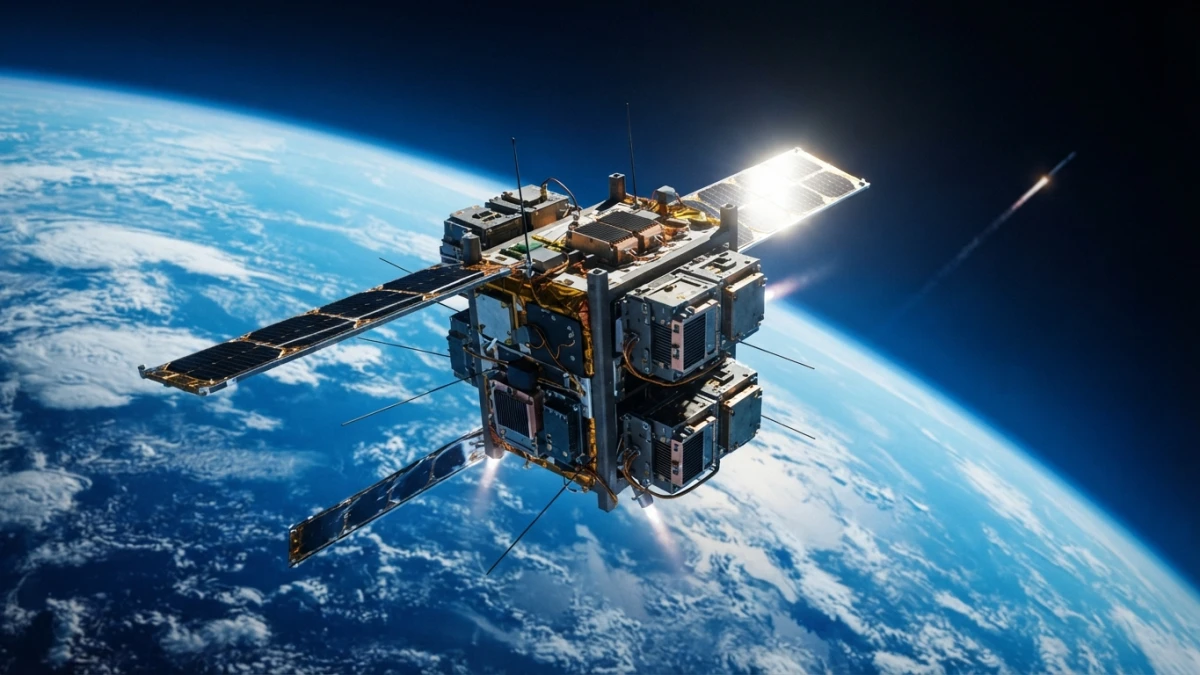
On October 1 a Falcon 9 placed the Project Suncatcher prototype in orbit with four of Google's TPUs on board. It isn't a data center: it's a test to find out whether AI chips survive space and, above all, heat.
What Launched on October 1
The event itself is simple to describe and easy to overstate. It is worth sticking to what Google confirmed and separating it from what has been inferred around it.
Falcon 9, the Transporter-18 Mission and Liftoff From Vandenberg
The prototype lifted off aboard a SpaceX Falcon 9 from the Vandenberg base in California as part of the Transporter-18 rideshare mission, which carried about 130 payloads. Liftoff came around 2:32 p.m. Eastern and left the satellite in a dawn-dusk sun-synchronous low Earth orbit roughly 650 kilometers up.
A Fridge-Sized Satellite With Four Trillium TPUs and 1 kW of Solar Power
The spacecraft, which the team calls MVP (minimum viable product), was built by Planet Labs. It is roughly the size of a refrigerator and carries four Trillium-generation TPUs, the same chips Google uses in its terrestrial data centers, powered by solar panels rated at about one kilowatt. In compute terms that is roughly a single rack server: the scale matters, because it keeps the test from being confused with a real deployment.
Read also

Google Confirms Contact: the Prototype Is "Operating as Expected"
Travis Beals, who leads the project, confirmed on Google's blog that the team had made contact with the satellite and that it was operating as expected. Alongside the launch, the company published a peer-reviewed paper in the journal Joule covering the research behind the mission.
What the Prototype Actually Tests (and Doesn't)
This is the key to reading the news properly, because the easy headline ("Google already has a data center in space") is false.
Not a Data Center: a Hardware Learning Mission
Google itself describes Suncatcher as a decade-long research project. What just went up is an experiment: it wants to learn how its chips behave in orbit, gather data that cannot be produced in a ground lab and refine the design of future versions. There is no service, no customers and no one querying anything from space.

The Three Threats in Space: Launch Shock, Radiation and Temperature
The mission measures three things. The first is the physical stress of flight: launch lasts about ten minutes with sustained accelerations of up to ten times gravity, and individual components such as the chips themselves can take forces of 50 to 100 g. The second is radiation: outside the atmosphere, particles from the sun and cosmic rays can flip bits in memory or degrade silicon. The third is thermal swing, with sunlit and shadowed phases shifting temperature by more than 100 degrees.
Why Four Chips Instead of a Rack: Measure Before You Scale
Google does not need to prove it can build a data center; it needs to know what breaks first in space. Four chips are enough to get that answer at the lowest possible launch cost. That is the logic of a prototype: find the failure point before committing to a large design.
Heat: Why the Vacuum Changes Every Rule
Radiation dominated pre-launch coverage, and the ground data was reassuring: Google's chips withstood radiation doses above what they would accumulate in five years of mission. The real problem is something else.
On the Ground Heat Leaves With the Air; in Orbit It Can Only Be Radiated Away
In a terrestrial data center, heat is carried off by air or by liquid flowing through cold plates. In a vacuum there is nothing to hand it to: the only route is radiating energy into space as infrared light. And radiating well demands very large surfaces, because radiated power depends on area and on temperature raised to the fourth power. That is why the satellite needs radiators and heat pipes to pull heat away from the chips and release it outside.
Radiators and Burst Compute: the Limit That Isn't Solved Yet
Technical coverage of the launch describes the resulting pattern: at full load, the chips generate more heat than the radiator system can reject continuously, so computation runs in bursts of about fifteen minutes followed by a mandatory cool-down. That figure is not an official Google number from the announcement but the reading offered by analyses of the design: what the experiment must reveal is whether the radiators perform better in orbit than the thermal vacuum chamber tests predicted.
What This Means for Solar Power as an Advantage: Sun Without Clouds, Heat Without an Exit
In a sun-synchronous orbit the satellite gets near-constant sunlight and, according to Google's analysis, can generate up to eight times more solar power than an equivalent ground system, which faces night, clouds and seasons. The paradox is obvious: the advantage is having power to spare, and the problem is that the same power turns into heat that cannot be released.
The Money Math: $3,600 per Kilogram That Must Fall to $200
The experiment does not rest on physics alone. Behind it is an economic question Google also puts in writing.
The Launch Cost Assumption in Google's Own Analysis
By the company's own numbers, lifting one kilogram to low Earth orbit today costs around $3,600 on a reusable Falcon 9. For orbital compute to approach cost parity with terrestrial data centers on a per-kilowatt-year basis, that price would need to fall below $200 per kilogram by the mid-2030s. These are projections with their own assumptions, not established facts.
Cost Parity per Kilowatt-Year: When It Would Make Sense (and When It Wouldn't)
The $200-per-kilogram figure is not a marketing goal: it is the threshold where space would start to compete. And getting there is not free. The published model points to the need for on the order of 180 Starship launches per year for a decade to push prices down that curve, something nobody has demonstrated yet. Put another way, the viability of orbital data centers depends in good part on someone else's rocket program.
What Skeptics Say About Orbital Data Centers
Not everyone believes the model will work. Some argue that renewable energy on the ground will stay cheaper than any advantage that offsets the cost of lifting every kilogram. Others point to two problems the announcement does not address: the impact on the upper atmosphere of constantly replacing hardware, and space debris. One debris-risk analysis suggests that a cluster of 81 satellites, the size described in the reference design, would encounter debris larger than a grain of sand roughly every five seconds.
What Comes Next: Two Satellites and Optical Links in 2027
The October prototype is the first step in a public roadmap, not the final product.
The Learning Mission With Planet Labs and the Laser Links Between Satellites
The next milestone is a learning mission with two satellites around early 2027, meant to test optical links between them. The idea is to connect several satellites with very high-speed lasers so they work as one distributed computing system. In the lab a demonstrator reached 1.6 terabits per second bidirectional; the orbital challenge is pointing precisely between two objects moving at tens of thousands of kilometers per hour.
Designs Under Study for Large Constellations: Ambition, Not a Confirmed Plan
The reference design Google works from describes satellites with dozens of chips each, grouped in clusters, with figures like the 81 units that appear in the debris-risk analysis. That is an architecture exercise, not an approved plan with a date: Google has not announced a commercial deployment.
The Context: the Race for Orbital Data Centers
Energy, Land and Water: the Problem Space Promises to Sidestep
Terrestrial data centers increasingly run into three limits: electricity, land and water for cooling. The promise of space is an almost continuous solar supply, with no ground to buy and no rivers to spend. That is why the idea has moved from curiosity to research line.
Who Else Is Looking Up: SpaceX, Other Tech Firms and the Cross-Investment
Space is not Google's alone: SpaceX is developing its own space compute capability and several tech firms are exploring the concept. One extra layer of interest is that Google is an early investor in SpaceX; according to regulatory filings reported by the press, it held around 6 percent of the company at the end of 2025. That is a context detail, not a joint plan. And to gauge the scale of the chip and infrastructure race the industry is running, on this blog we have followed OpenAI's inference chip, Meta's own AI chips and the memory shortage stretching to 2028.
What Is Still Unknown
There are no public performance figures for the TPUs in orbit, no answer yet on whether the cooling system will survive real thermal cycling, and no measure of how much the solar panels will degrade over time. There is also no date or budget for a commercial deployment. The mission is expected to last about a year, and the satellite will stay in orbit for up to six before reentry.
Conclusion
Project Suncatcher has not put a data center in space: it has put four chips up there to discover why that can't be done yet. If the answer is that heat is managed better than expected, the next step is the 2027 optical links. If not, the headline that matters won't be the launch but the physical limit that shows up in the telemetry. Follow the blog's infrastructure and AI coverage to see how this race evolves.