Meta Will Deploy Its Own AI Chips in 2027: What MTIA 450 and 500 Are

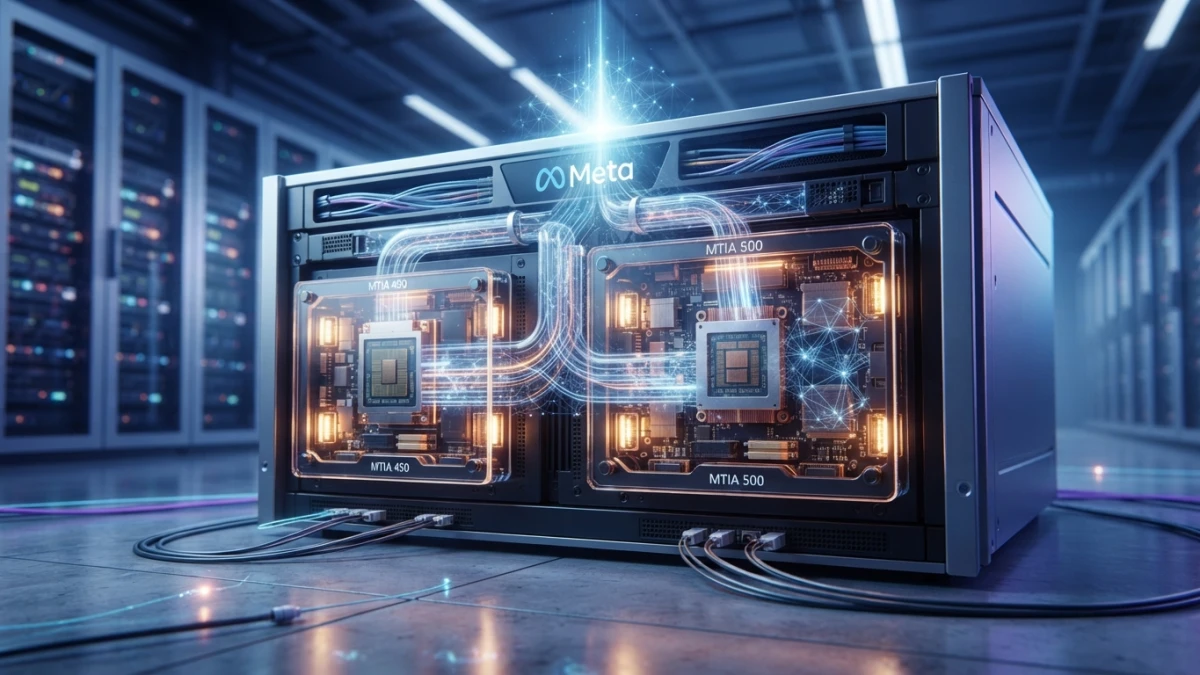
Meta has a timeline for its own AI chips: MTIA 450, codenamed "Arke," arrives in its data centers in the first half of 2027, while MTIA 500, "Astrid," finishes design work within weeks.
What Meta Announced, and What It Did Not
The news landed on September 15, 2026, and it describes a deployment plan, not a product on sale. Arke is in testing and its data center arrival is set for the first half of 2027; Astrid, the next generation, has not finished design work and would enter production toward the end of that same year.
That nuance matters: these are the company's own dates and estimates. There is no independently measured hardware for either generation yet, so the efficiency figures attached to the announcement should be read as vendor claims.
What MTIA Is and Where It Comes From
MTIA stands for Meta Training and Inference Accelerator, the in-house silicon program the company started in 2023. In March 2026 it unveiled four generations of the family: MTIA 300, already in production, the 400 known as "Iris," the 450 "Arke" and the 500 "Astrid," on a refresh cycle of roughly six months. Yee Jiun Song, Meta's vice president of engineering, described that pace as unusual for any silicon company.
Read also


What This Silicon Is For (and What It Is Not)
MTIA 450 is aimed mainly at generative AI inference, including workloads that produce images and video from text prompts, on top of the recommendation systems that earlier generations already handle: the quiet work that decides what shows up in an Instagram or WhatsApp feed. What it does not do is train frontier models, which is why Meta's program lives alongside massive GPU purchases from Nvidia and AMD rather than replacing them.
The Argument Behind the Move: Energy and Cost
At billions of requests, the metric stops being FLOPS alone and becomes how much it costs, in watts and in dollars, to produce each token. That is where a custom accelerator can beat a general-purpose one: not by winning a speed test, but by doing this specific work with less energy.
Meta's partnership with Broadcom was extended through 2029 and includes an initial deployment of more than a gigawatt of MTIA silicon built on a 2nm process. The company is also targeting roughly 14 GW of total compute capacity in 2027: that figure is its data center capacity goal, not the power draw of MTIA chips.

The Fine Print of "In-House Chips"
The first catch is that declared efficiency is not audited efficiency: Meta benchmarks its chip against alternatives in scenarios it defines itself, and until third-party measurements exist on production hardware, the savings cannot be confirmed. The second is fragmentation: every accelerator comes with its own software stack, so code written for one cannot always move to another without extra work.
What It Means If You Write Code
Indirectly, and gradually. If inference gets cheaper inside the hyperscalers' data centers, the cost per token tends to fall for anyone consuming those services through an API. And the same push for efficiency drives the other path: models that run on your own machine, with no one in between.
Conclusion
Meta's in-house AI chips are a bet on cutting the energy and compute bill of an operation that keeps growing, and they now have dates attached. What is missing is verification: until Arke and Astrid are in production and independent measurements exist, everything else is a well-argued promise.
If silicon is your thing, there is my breakdown of China's AI compute plans for 2030, the look at Meta's local model Muse Glimmer and the AI chip battle.