
Apple Enters the Smart Home: $299 HomeView, a New Apple TV 4K and Accessories Built With LG and Schneider

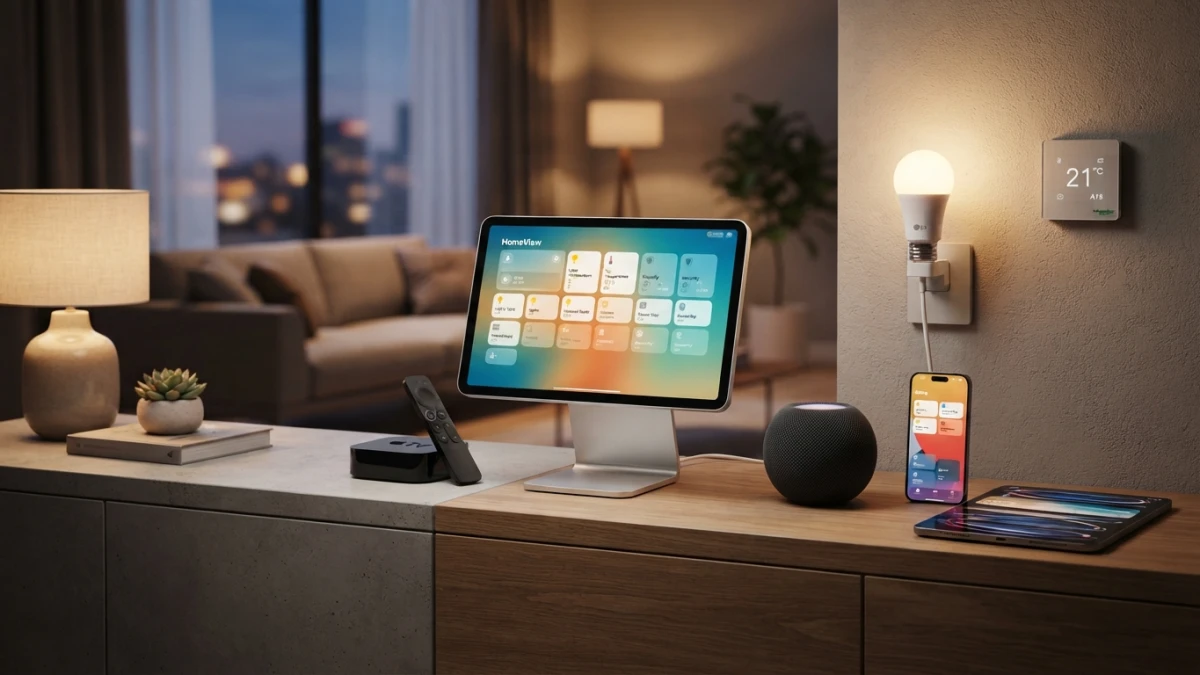
On October 13 Apple unveiled its first home screen: Apple HomeView, $299, an A18 chip and Siri AI in beta, shipping November 13. Alongside it came a pricier Apple TV 4K, a HomePod mini 2 and an accessory line Apple isn't making: LG and Schneider are.
The event was called "Welcome Home" and was not livestreamed. It was a closed press briefing in New York where Apple showed seven home products and, for the first time, a complete strategy for the connected home. Here is what was announced, at what price, and with which fine print.
What Apple Announced on October 13
HomeView: $299, a 7-Inch Display and Two Versions
Apple HomeView is a square 7-inch Liquid Retina display attached to a speaker base by a stainless steel hinge. It comes in two formats, tabletop and wall-mounted, and both cost $299. It runs on the A18 chip, the same class of silicon that debuted in the 2024 iPhone generation, and it runs Apple Intelligence with Siri AI.
Its most distinctive feature is not the screen but the camera: HomeView recognizes up to six people by face and switches the on-screen profile depending on who is standing in front of it. That lets each person see their own widgets, reminders and conversations while the rest of the household shares photos and music. Apple describes that processing as local, isolated in protected areas of the chip called Secure Exclaves, and adds that personal content only appears when the recognized user's iPhone is nearby and has been unlocked recently.
Read also

Apple TV 4K: A19 Chip, AV1 and a Higher Price
The new Apple TV 4K (fourth generation) uses the A19 chip, with a dedicated AV1 decoder for more efficient streaming. Apple sums it up in two numbers: up to 50% faster CPU performance and twice the GPU performance of the previous generation. The Siri Remote gains Find My support, Precision Finding and an option to play a sound if it disappears between the couch cushions.
The awkward part: it costs $299, well above what the previous generation cost. In exchange you get more storage and connectivity, and above all the ecosystem: paired with four HomePod mini 2 or second-generation HomePod speakers, the box builds surround sound for your TV.
HomePod mini 2: $149 and on Sale October 30
The small speaker is also being refreshed after years without changes. It runs the S10 processor and, according to Apple, will be the first home product to receive Siri AI, though through a later software update. Price: $149. Date: October 30, 2026.
Apple Home Collection: Cameras, Doorbell, Lock and Thermostats
The most interesting part of the event is not an Apple product. Apple Home Collection is a lineup of smart home accessories designed in collaboration with LG Electronics and Schneider Electric: four cameras (indoor, outdoor, a floodlight cam and a dual-camera video doorbell), a smart deadbolt lock with a digital key, thermostats and temperature sensors. They set up with one tap from an iPhone and are managed from the Home app, with no separate app or account, and they are Matter compatible.
One detail was widely misreported on event day: availability is not "someday". Apple says the lineup starts selling in December, with select accessories arriving in early 2027. Accessory prices have not been published yet.
Prices and Dates: Preorder Is Not Availability
- Apple HomeView (tabletop and wall-mounted): $299. Preorders open since October 13; available November 13. It is not sold in the European Union because Siri AI is currently unavailable in iOS in that region, according to Apple.
- Apple TV 4K (4th generation): $299. Preorders since October 13; in stores November 13.
- HomePod mini 2: $149. On sale October 30.
- Apple Home Collection: no published prices. Availability from December, with part of the lineup in early 2027.
- Schneider Home wall mounts (for the wall model): $59.95 for the USB-C connector, $79.95 for the wired AC version, and $129.95 for the Power over Ethernet mount, arriving in early 2027.
The distinction matters: being able to preorder a product is not the same as owning it. Anyone buying today for the AI is paying for hardware with promised software: on HomeView the feature ships in beta with software version 27.2, and on the HomePod mini 2 it is still waiting for an update.
Why HomeView Is More Than a Speaker With a Screen
Apple's First Screen Designed for the Home
It is not a recycled iPad or a HomePod with glass on top. Apple designed it like furniture: it sits on a kitchen counter, a nightstand or an entryway table, or it bolts to a wall. And whether it is late on purpose or not, it arrives in a market where Amazon (Echo Show) and Google (Nest Hub) have been selling home displays for years.
Siri With AI, Now on an Always-On Display
Apple's real move is giving its assistant a face. Siri AI stops living hidden in your pocket and moves onto a screen that is on all day. Apple is clear about one caveat: without an Apple Intelligence-enabled iPhone or iPad, personal context features are limited; general knowledge and conversation still work, but the "Siri that knows your stuff" needs the phone.
Recognizing Faces to Give Everyone Their Own Profile
Facial recognition is what turns a home panel into something personal. Apple does not detail how much data is stored or where, beyond describing the processing as private and on-device. It is a convenient feature and also the one that raises the most questions: read the official terms before drawing conclusions.
Apple Isn't Making the Accessories: What That Means
Matter in Two Sentences
Matter is an open standard that lets devices from different brands understand each other. Instead of locking a home to a single vendor, Apple is selling accessories that also work in other ecosystems.
LG and Schneider Electric: the "Brand Plus Partner" Model
The cameras and the lock are LG's; the thermostats come from Schneider Electric. Apple provides the integration, the Home app and the certification; the partners bring the factory and the inventory. For buyers the practical difference is good: less exclusivity and more interoperability. For Apple, it means entering the home without carrying the margins of third-party hardware.
What This Means If You Develop or Work With 3D
The Home as a Platform
Apple Home, Matter and Siri stop being an accessory: they become a surface where devices get integrated. If you develop for Apple, the home is now one more platform to consider.
Playback Hardware Is Not Compute Hardware
Neither the Apple TV 4K nor the HomeView is a rendering machine. They are playback and preview devices: the Apple TV with its A19 chip handles 4K video and, with four speakers, builds surround sound. Useful for reviewing material, not for producing it.
Processing at Home vs Processing in the Cloud
The idea that the device in your house can handle things without sending data outside has years of history in open-source software, and Apple is applying it in its own way. If that approach interests you, we already explained how to run language models on your own machine with Ollama and why assistants that live on the device are the trend Meta is pushing too.
What to Do Today: Buy, Wait or Skip
If you want a home display and you already live inside Apple's ecosystem, you have one clear date: $299 and November 13, knowing the AI arrives in beta. If what you want are sensors, cameras or a lock, the sensible move is to wait for December, when there will be prices and comparisons with what already exists in Matter. And if you own a recent Apple TV 4K, the headline of the new model is the price, not a feature you were missing.
What to Watch Over the Next Few Weeks
- October 30, the HomePod mini 2 launch.
- November 13, the HomeView and Apple TV 4K launch.
- December and early 2027, with the Apple Home Collection accessories and their prices.
- The moment Siri AI leaves beta and stops depending on a specific software version.
- The second event some outlets place on October 27: that is a rumor, not an announcement.
Conclusion
Data: HomeView costs $299, runs an A18 chip, recognizes six people and ships November 13. Promise: Siri AI in beta, accessories without a price and a lineup that starts in December. Between those two columns lies the answer to whether this is the year Apple truly enters the home or the year it announced it.
If you are interested in how the technology we use every day gets built and measured, we keep publishing breakdowns and tutorials on the blog: keep reading Blender Deluxe.