Meta Opens the Weights of Muse Spark Open: 816 Billion Parameters Running on Two Mac Studios

Meta released the weights for Muse Spark Open, the first open release from its flagship family: 816 billion parameters, a one-million-token context and, according to the company, the ability to run on two M5 Ultra Mac Studios. What ships and what the license allows.
What Meta Released on October 15
Meta Superintelligence Labs released the weights for Muse Spark Open on Thursday, October 15, the first open-weight model in the Muse Spark family, which had been closed until now. They are available on Hugging Face. The company presents it as the most capable US open-weight model to date, a claim of its own: there is no full independent evaluation backing it yet.
816 Billion Parameters, 42 Billion Active
It has roughly 816 billion parameters and activates about 42 billion per token. That gap is the key to its mixture-of-experts (MoE) architecture: each layer holds 256 expert networks and a router picks 8 of them for every token. All the experts take up memory, so deploying it needs the memory of an 816B model, but it computes at the speed of a much smaller one.
A One-Million-Token Context and Native Multimodality
The context window reaches 1,048,576 tokens. It accepts text, images, audio and video as input and returns text, with a 1.8-billion-parameter perception encoder for visual input and another for audio.
Read also


Built for Coding Agents
Meta trained it to read a codebase, write and debug code, refactor several files, sustain long debugging sessions and call tools. It supports configurable reasoning at four levels and native tool calling.
What "Open Weights" Means (and What It Doesn't)
Open Weights, Open Source and a Closed API: Three Different Things
Releasing weights means the model file can be downloaded and run on your own hardware. It does not mean the training data or the full code are published, and it does not mean support is included. That differs from a closed API, where you pay per token remotely, and from strict open source, where how it was built is also released.
The License: Muse Model License, Not a Permissive One
The weights ship under the Muse Model License, a license Meta wrote itself. In practice: you can download it, but before putting it into a product you should read that license carefully. It is not a permissive license and it does not include support.
Why This Is Not "the Most Capable Model in the World"
Meta says it is the most capable in the United States, not in the world, and compares it with Chinese open models. That is a vendor claim: until there are comparable independent benchmarks, it cannot be taken as fact.
Where Muse Spark Open Runs
Two M5 Ultra Mac Studios and MLX: the Desktop as a Server
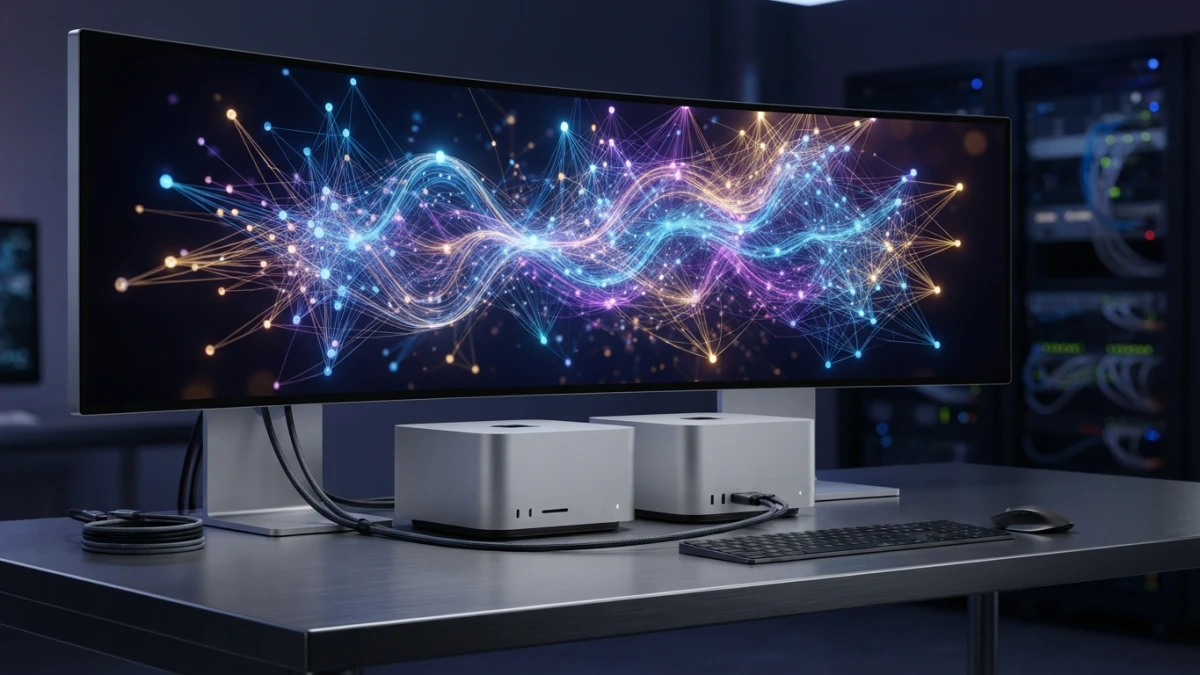
The story that drew the most attention is the local one. Meta says it is the first model in its class to run on a desktop with two M5 Ultra Mac Studios and the MLX framework, and that it worked with Apple on the launch. The model is available in oMLX and mlx-lm, with 3-bit and 4-bit quantizations. Hugging Face tested a 3-bit one on a machine with 512 GB of unified memory: it took about 344 GB and generated at around 21 tokens per second. That is a lab figure, not an official benchmark, and it makes the real point clear: you need a very high-end machine.
vLLM, SGLang and llama.cpp: the Server Path
On servers it works with vLLM, SGLang and llama.cpp, plus the Transformers library. The full BF16 weight is about 1.5 TB and is spread across several GPU nodes; there is an NVFP4 version at 4 bits for NVIDIA's Blackwell GPUs.
Day-One AMD Support: 8 Instinct GPUs and 288 GB of HBM3E Each
AMD shipped support on the same day for its Instinct MI350X and MI355X GPUs: a single node of 8 GPUs, with 288 GB of HBM3E per card, 8 TB per second of bandwidth and tensor parallelism across all eight, on top of ROCm and vLLM. This path also needs a rack, not a desk.
What It Actually Costs
The Weights Are Free; the Hardware Is Not
Downloading the weights costs nothing. Running them does: unified memory or HBM GPUs, plus power and maintenance. The model is free; the machine that makes it work is not.
Third-Party APIs and Their Price per Million Tokens
You can also use it without downloading anything. On OpenRouter it lists at 1.25 dollars per million input tokens and 4.25 per million output tokens, with cache reads at 0.15, served by several inference providers. For most teams it remains the sensible option until volume justifies owning hardware.
Three- and Four-Bit Quantizations: What You Gain and Lose
Lowering precision cuts the memory needed and lets the model fit on more modest machines, at the cost of a small quality loss. It is the adjustment that makes a model this size possible outside a data center.
What You Gain and What You Give Up
Privacy and Data Control: the Strongest Argument
If the model runs on your hardware, the prompt never leaves the building. For anyone working with proprietary code or sensitive data, that is the main reason to self-host an open model.
Predictable Cost at Scale Versus a Per-Token Bill
With your own hardware you pay once and then for power; with an API you pay per use. At high volume the machine pays for itself; at low volume, almost never.
What You Lose: Support, Updates and a Custom License
- No vendor support: if something breaks, you fix it in-house.
- Manual updates: every new version has to be deployed yourself.
- A custom license to read before commercial use.
- Hardware: you need an expensive machine most teams do not have.
How It Fits the Rest of Meta's Lineup
Muse Glimmer and This Model Are Not the Same
Meta had already opened a small model from the same series, Muse Glimmer, in August, built to run on a single machine. They share a tokenizer and chat template, but they are different sizes and purposes.
Muse Code and Meta's API: the Closed Road Still Exists
The model is also offered through Meta's paid products and third-party providers: the enterprise AI stack Meta introduced in late September is still sold as a closed service.
Open Weights as an Answer to Chinese Models
The press read it as the US answer to Chinese open models. That should be kept separate from Mistral Large 4, which announced open weights for the end of the month: another release, another license and another approach.
Conclusion
The facts: Meta released the Muse Spark Open weights on October 15, with 816 billion parameters, a one-million-token context, native multimodality and the Muse Model License, available on Hugging Face and through API providers. Meta's claim: that it is the most capable US open-weight model. For anyone with sensitive data or high volume, self-hosting is starting to make sense; for everyone else, the API remains the reasonable choice.