Cycles vs EEVEE in Blender 5.2: When to Use Each Render Engine

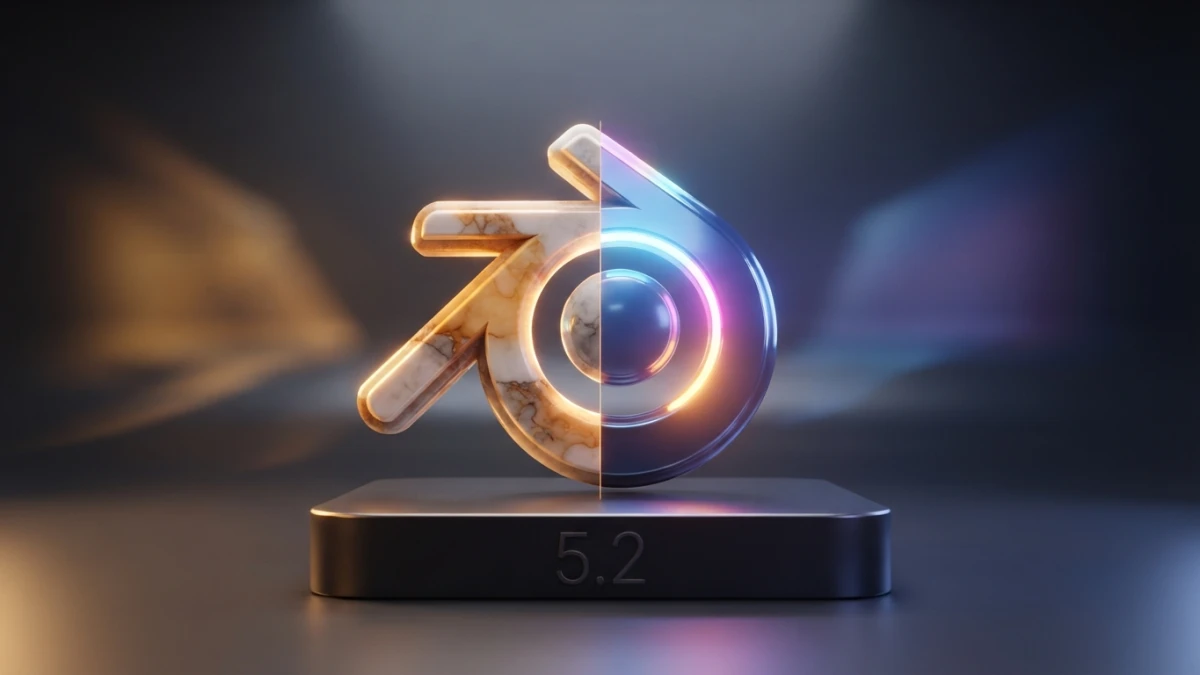
Choosing between Cycles and EEVEE in Blender 5.2 can split your render time between minutes and hours: one engine simulates light with path tracing, the other approximates it in real time. This guide compares both with data and lays out a hybrid workflow to decide with confidence.
How Each Engine Thinks: Path Tracing vs. Rasterization
The fundamental difference between Cycles and EEVEE hasn't changed in version 5.2: they are two opposing strategies for answering the same question, how light reaches each pixel of your final image. Understanding that foundation is the key to knowing when Cycles is worth the wait and when EEVEE gives you everything you need instantly.
Cycles: Physical Light Simulation
Cycles is a physically based path tracer. It casts rays from the camera through the scene and computes, bounce after bounce, how light scatters, reflects, and refracts as it hits each surface. From that simulation emerge naturally the effects we associate with photorealism: accurate reflections, refractions with dispersion, ambient occlusion, and even caustics. That realism has a clear cost: every pixel needs dozens or hundreds of samples to converge, and a final render can take anywhere from minutes to hours depending on scene complexity, resolution, and available hardware.
EEVEE: Screen-Space Tricks and Light Probes
EEVEE, on the other hand, is a real-time rasterizer. Instead of simulating every ray, it projects geometry directly onto the screen and approximates indirect lighting with precomputed light probes and screen-space techniques. It's the same strategy used by game engines: you get a sharp, interactive image at 60 fps or more, with the trade-off that certain physical effects, such as reflections of objects outside the frame, need manual help or the activation of its dedicated raytracing.
What Changed in 5.x: From EEVEE Next to EEVEE 5.2
The recent history of both engines explains why the decision is no longer as polarized as it used to be. EEVEE stopped being the "cheap" engine it once was, and Cycles has gained speed exactly where it hurt the most.
EEVEE's Per-BSDF Raytracing
With Blender 4.2 LTS, released in July 2024, the new generation of the engine arrived, known as EEVEE Next, which completely replaced the legacy pipeline. Its key contribution is a raytracing pipeline that casts a ray from each BSDF, that is, from each material, to increase the accuracy of surface indirect light. When you disable that option, the engine falls back to the fast path based on prefiltered light probes. The result is that EEVEE can produce far more believable reflections and indirect lighting than the classic version, without losing viewport interactivity.
Cycles Improvements in 5.0 and 5.1
Blender 5.0, released in November 2025, brought Cycles a new volume algorithm called null-scattering, enabled by default, which improves the look of smoke, fog, and other volumetric effects with less noise in fewer iterations. The same release sped up shader compilation on NVIDIA GPUs. Blender 5.1 added memory savings in EEVEE by overlapping framebuffers and render textures at different points of the frame, plus support for the Light Path node in the World. The 5.2 LTS, released in July 2026, consolidates both lines as the stable foundation to work on.
Practical Comparison: When Cycles Wins and When EEVEE Wins
| Criterion | EEVEE | Cycles |
|---|---|---|
| Speed | Real time, interactive in the viewport | Slow: from minutes to hours per frame |
| Light quality | Approximate, improvable with per-BSDF raytracing | Physically accurate, true global illumination |
| Reflections and refraction | Screen-space or limited raytracing | Full, including caustics and dispersion |
| Typical use | Lookdev, previews, animation, stylized looks | Final renders, product, architecture, realism |
| Resources | Low, runs on almost any GPU | High, rewards powerful GPUs and generous RAM |
Lookdev, Animation, and Previews with EEVEE
EEVEE shines in the phases where speed rules. During lookdev you can test materials, lights, and composition with immediate feedback, without waiting minutes for every attempt. In animation, previewing motion and camera moves in real time makes EEVEE the natural tool for blocking and previs. And if your project is going for a stylized or game-like aesthetic, EEVEE's controllable lighting can actually be easier to direct than Cycles'.
Photorealism and Final Renders with Cycles
When the goal is for the final result to look like a photograph, Cycles is still the king. Physically accurate global illumination, correct reflections, and caustics emerge from the simulation with no manual intervention, which is essential in product, architecture, and any job where the client compares your render to a real photo. Here render time isn't a drawback; it's the investment that guarantees the quality.
When EEVEE Can Be Your Final Engine
Not everything that gets published needs path tracing. If your project is a long animation with dense scenes, a video game, or an interactive architectural walkthrough, EEVEE can be a legitimate final engine. With per-BSDF raytracing enabled and well-placed light probes, the gap with Cycles narrows a lot, and the time savings are enormous. The practical rule: if the final render with EEVEE passes your quality bar, only switch to Cycles for the shots that demand it.
The Hybrid Workflow: One Project, Both Engines
The approach most studios recommend in 2026 is combining both engines in the same project instead of picking one forever. The usual flow works like this: you model and set up the layout with EEVEE, test lights and materials in real time, produce animation previews with EEVEE, and once the scene is locked, you switch to Cycles for the final render.
The concrete setup is straightforward. In EEVEE, open the render properties and find the Raytracing section: enable it so each BSDF casts its rays, and tune trace precision according to the quality-versus-performance balance you need; disable it to return to the fast light-probe pipeline. In Cycles, control quality from Samples (for example, 128 for tests and 1024 for finals), enable denoising with OpenImageDenoise to clean up noise in post, and review Light Paths to limit light bounces, which is where much of the render time hides. Save both setups as scene presets and switch between them with a single click.
Conclusion
In Blender 5.2 there is no superior engine in the abstract: there is an engine for each phase of the work. EEVEE gives you speed and immediate response to explore, and Cycles gives you the physical realism that final renders demand. Understanding how each one thinks, taking advantage of EEVEE's per-BSDF raytracing, and combining both in a hybrid workflow is the most efficient way to work. If you want to go deeper into scenes and procedural composition, don't miss our beginner's guide to Geometry Nodes in Blender 5.2.