Livewire 4 vs Inertia 3 in Laravel 13: How to Choose Your Frontend Stack

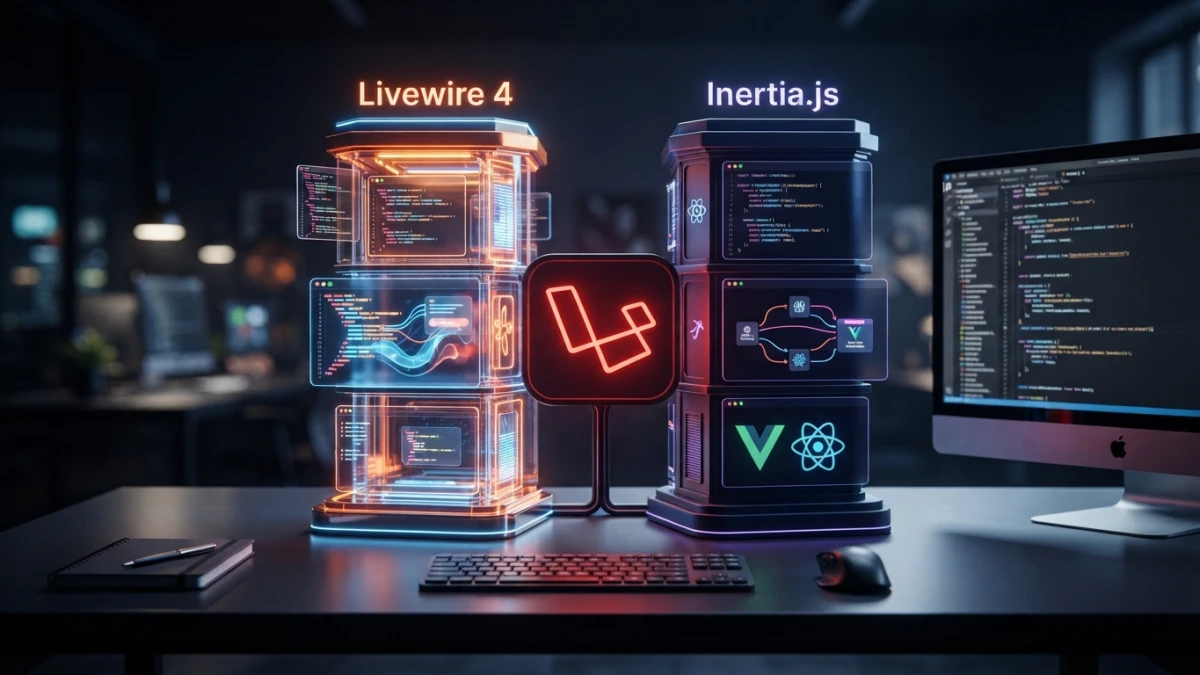
Livewire 4 vs Inertia 3 in Laravel 13: picking your frontend stack shapes your project's architecture for years. This guide compares both official stacks, reviews what's new in each 2026 release, and gives you practical rules to decide without painful refactors.
What Livewire and Inertia Are in Laravel 13
Both solve the same problem: building reactive interfaces without splitting the frontend into a separate project or writing your own JSON API. The difference is where the logic runs and what travels over the network.
Livewire: PHP on the Server and DOM Diffs Over the Wire
Livewire runs the logic in PHP. Each component lives on the server, and when the user interacts, the library sends only the needed state over the wire and returns HTML patches that update the page without reloading it. The result is an SPA-like experience with a team that writes PHP and Blade and never touches JavaScript.
Inertia: JSON Props and Vue, React, or Svelte Components
Inertia works the other way around: the server responds with JSON props and rendering happens on the client with Vue, React, or Svelte components. You don't build an API because Laravel controllers return data instead of views, but the frontend is real JavaScript, with its tooling, its state, and its component frameworks.
Read also

What They Share: The Laravel Monolith Without an API Layer
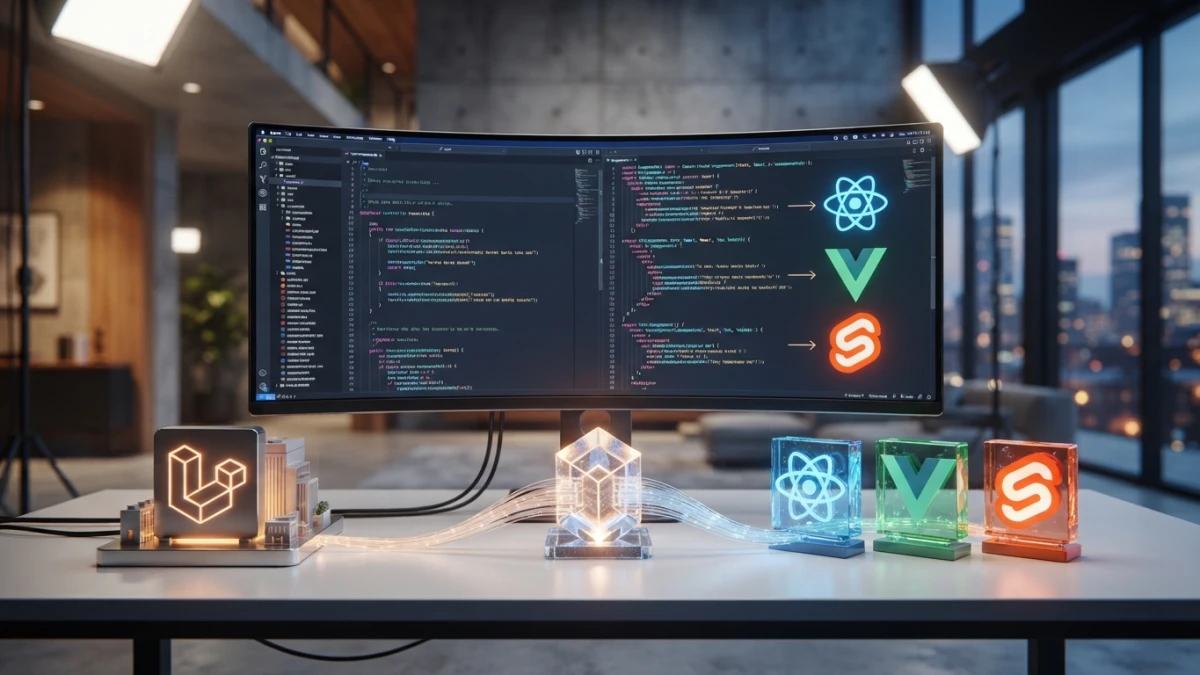
The key point: both keep your application as a Laravel monolith. Routes, controllers, validation, Eloquent, and Blade stay in the same place, with no CORS, no double deployment, and no versioning two projects. The choice doesn't change the backend architecture, only the presentation layer.
What's New in Livewire 4
Laravel News called Livewire 4 the biggest release of the library to date, focused on better defaults, less friction, and more powerful tools. The upgrade from v3 keeps backward compatibility wherever possible.
Single-File Components: Component and View in One File
The view-first system lets you declare the component and its template in a single PHP file. Fewer files to jump between, less boilerplate, and a pattern closer to how a Laravel developer thinks: logic and markup together, with @php and @assets when you need them.
Islands: Per-Component Isolated Hydration
The Islands architecture changes how the page hydrates: instead of activating the whole document, each reactive component hydrates independently. That reduces initial JavaScript and means a page with several reactive widgets doesn't pay the cost of the ones the user hasn't touched yet.
wire:sort, JS Interceptors, and wire:navigate
Version 4 adds wire:sort for drag-and-drop list reordering without extra logic, JavaScript interceptors to hook into the request lifecycle, and a more mature wire:navigate that turns links into SPA transitions with prefetching. The result is a PHP-first stack that feels much closer to a client-side app.
What's New in Inertia 3
Inertia 3 entered beta on March 5, 2026, and went stable at the end of the same month. The official upgrade guide describes it as a major release focused on simplicity and developer experience, and the changes follow that line.
Async Requests, Deferred Props, and Prefetch
You can now fire requests without blocking navigation, defer heavy props so the page paints first, and prefetch likely destinations before the user clicks. These are optimizations that used to require external libraries or manual code and now ship out of the box.
Native Optimistic Updates: The UI Responds Instantly
The optimistic() method updates the interface before the server confirms, with automatic rollback on failure. For actions like favoriting, voting, or quick state changes, the app feels instant without managing optimistic state by hand.
Goodbye Axios: Custom HTTP Client and a Smaller Bundle
Inertia 3 drops the Axios dependency and ships its own HTTP client through useHttp. Fewer dependencies, less weight in the final bundle, and an API better integrated with the rest of the library.
SSR with Vite Working in Development Out of the Box
Server-side rendering with Vite works in development without extra configuration, removing one of Inertia's classic pains for SEO and first load: setting up SSR used to be a project of its own, and now it turns on with little effort.
Practical Comparison
Perceived Performance: HTML Patches vs Client-Side Rendering
In interactions, Inertia responds without waiting for the server on every change, so feedback is immediate in dashboards with complex state. Livewire, on the other hand, pays a round trip per interaction; on mobile networks with high latency it shows, with figures around 350 ms per interaction in some 2026 analyses. Neither is an absolute truth: the recommendation is to measure with your own app and audience, because Livewire avoids the cost of downloading and running a large JavaScript bundle.
Learning Curve: PHP-First Team vs JavaScript Team
If your team lives in PHP and Blade, Livewire is almost free to learn: components are PHP classes and templates are Blade. Inertia requires mastering a component framework (Vue, React, or Svelte), its state, and its tooling, which adds months of curve if the team doesn't come from that world.
Ideal Use Cases for Livewire 4
Long forms with server-side validation, admin CRUD, tables with filters and pagination, and any interface where business logic matters more than animation. The PHP-first pattern fits back-office work naturally.
Ideal Use Cases for Inertia 3
Dashboards with rich interaction, editors, kanban boards, complex drag-and-drop interfaces, and products where client state is the protagonist. If you need reusable React or Vue components, Inertia is the official path.
How to Decide: Practical Rules
Forms, Tables, and CRUD: Livewire
If 80% of your app is listings, forms, and admin screens, Livewire 4 solves the problem with half the effort and without splitting the team. A component with wire:model gives you fluid server-side validation:
<?php

namespace App\Livewire;

use Livewire\Component;

class ProductForm extends Component
{
    public string $name = '';
    public float $price = 0;

    public function save()
    {
        $this->validate([
            'name' => ['required', 'min:3'],
            'price' => ['required', 'numeric', 'min:0'],
        ]);

        Product::create($this->only('name', 'price'));
    }

    public function render()
    {
        return view('livewire.product-form');
    }
}
Rich Interactions and Complex State: Inertia
When the interface has client-side state changes, transitions, drag-and-drop, or components with their own logic, Inertia gives you the tools of the JS ecosystem. A form with Inertia 3 and useForm looks this direct:
import { useForm } from '@inertiajs/vue3'

const form = useForm({
  name: '',
  price: 0,
})

function submit() {
  form.post('/products')
}
Mixed Teams and Incremental Migration
The 2026 guides agree that the decision depends on the team and the type of interface, not on fashion. If your team is mixed, Inertia usually wins because it respects JavaScript profiles; if it's pure PHP, Livewire avoids a full retraining. And if you already have an app on one stack, migrating incrementally is viable: you can move screens one by one without rewriting everything at once.
Getting Started with Each Stack in Laravel 13
Laravel 13 was released on March 17, 2026, and requires PHP 8.3 or later. Both stacks have official starter kits, so the setup is identical up to the frontend install step.
The Livewire Starter Kit: create-project and Your First Component
composer create-project laravel/laravel example-app
cd example-app
php artisan install:livewire
The command sets up the Livewire starter kit with authentication, profiles, and a ready-to-use dark theme. Your first component is created with php artisan make:livewire, and the rest is PHP and Blade.
The React or Vue Starter Kit with Inertia 3
composer create-project laravel/laravel example-app
cd example-app
php artisan install:react
The React Starter Kit uses React 19, TypeScript, Inertia 3, and shadcn/ui; the Vue variant sets up Inertia with Vue 3 and TypeScript. Both include authentication and a set of example components that work from the first run.
Can You Combine Them in the Same Project?
Yes, and it's not uncommon. Livewire can live inside an Inertia app for specific components better solved in pure PHP, like an internal search box or a particular admin panel. The usual approach, though, is to pick one main stack and use the other as a justified exception, not as the default.
Conclusion
Livewire 4 and Inertia 3 are Laravel 13's two official bets for reactive interfaces without a separate API, and both are valid: the comparison is settled by your team and your interface, not by fashion. To go deeper, we already have full guides on Livewire 4 with Laravel 13 and Inertia 3 with Laravel 13; and if your decision points toward the web, our article on Vite and assets helps you set up the frontend. Keep reading the blog for more comparisons and practical web development guides.