OpenAI's Daybreak: agents that pentest your app and hand you the patch

OpenAI opened a waitlist for Daybreak Red Team, a product where fleets of agents run penetration tests against your web app, plus a preview of Defense Factory, which turns every finding into a pull request with a patch and a test. The striking part: no new model shipped.
What OpenAI announced on November 12
At the Cyber at the Frontier event, opened by Greg Brockman, OpenAI presented two products inside its Daybreak security platform, walked through by Nancy Wang. The press dated the announcement November 12, 2026, because the official product pages carry no date: worth saying whenever it is cited.
Daybreak Red Team and Daybreak Defense Factory are a workflow built on a base that already existed. What changed this week is not the model's weights, it is that the find-and-fix stretch went from demo to product with a waitlist.
What sits underneath: GPT-6 Cyber
The base is GPT-6 Cyber, published by OpenAI on November 5. By the company's own numbers, the model reaches 48.5% on ExploitGym against 32.1% for GPT-5.6 Cyber, with 0.07% out-of-scope actions without the deployment prompts and 0% with them. Those are vendor figures, not an independent audit. The 948 Linux kernel vulnerabilities case showed the same funnel: finding stopped being the problem.
Read also


Daybreak Red Team: you define the scope
The difference from a classic scanner is not raw power, it is permission. Here the operator decides what can be touched before the agents enter the scene.
What a fleet of agents does to a web app
Coordinated agents hunt for attack paths in web applications, validate findings that already came from scanners, a bug bounty program or a disclosure report, and re-test after the fix to check whether the exploit still works. That re-test is the part almost nobody does by hand: confirming the patch actually closed the hole.
Guardian, isolated environments and the operator's rules
Scope is set by whoever buys it: which applications and endpoints can be touched, whether synthetic data is allowed or read-only only, how long the test runs and what is excluded. Agents run in isolated environments and a review layer called Guardian enforces those limits. Nothing is deployed automatically: the product tests and validates.
Defense Factory: from finding to pull request
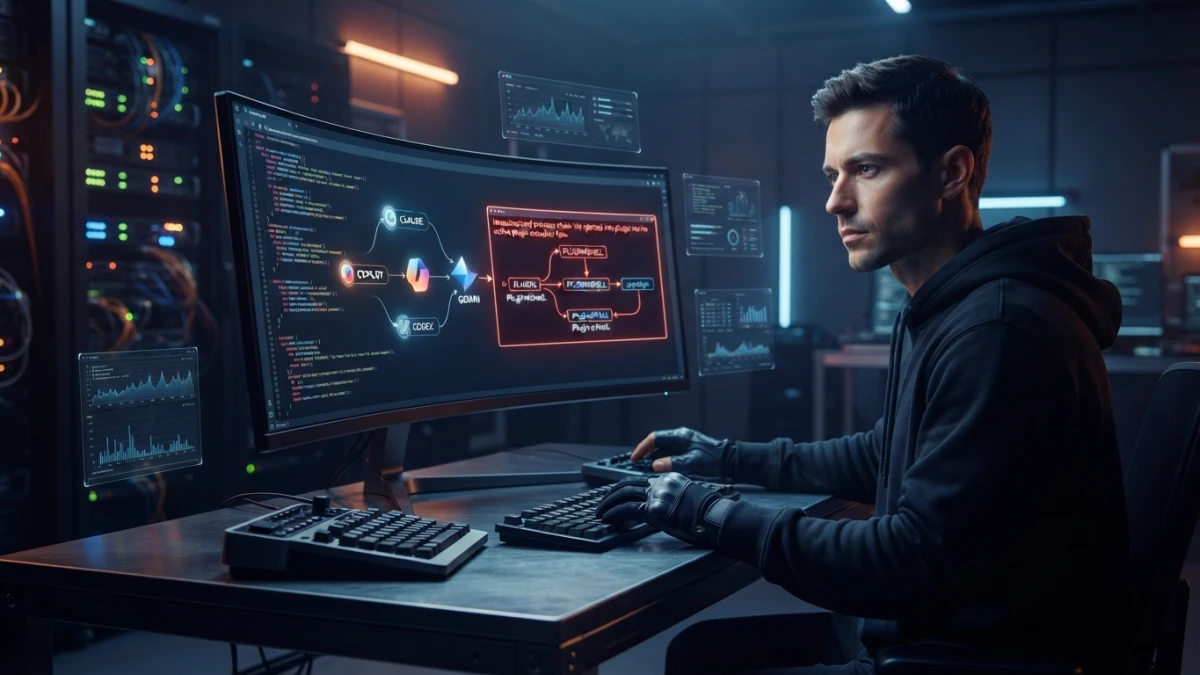
It installs as a plugin inside Codex or ChatGPT in workspaces that already have Daybreak access, and there is also a Codex Security CLI and SDK for the terminal and custom integrations.
How it traces the flaw into the code and finds the owner
It scans the repository in reproducible cloud environments, traces each finding down to the affected code, uses repo history and team structure to work out who owns it, and delivers a pull request with a patch and a test. An engineer reviews and tests before merging: it does not patch on its own, it leaves the work ready for someone to approve.
Integrations and continuous scanning
It reads findings from tools teams already run, such as Wiz, Snyk and Endor Labs, and according to OpenAI it also accepts whatever Red Team produces. It can scan new commits or run scheduled checks, with a configurable history window and threat model. The company set its own realistic expectation: scanning a large repository can take several hours.
Who gets in, and what it costs
None of this is general availability and the price is not published. Two facts worth having straight before getting excited.
Daybreak Blue and Daybreak Red are not the same thing
Daybreak Blue is the defensive program with the main models; Daybreak Red is the authorized red teaming, exploit validation and controlled research track, with separate approval and verification of the applicant and the intended use. And watch the easy confusion: Daybreak Red Team is the pentest product, Daybreak Red is the access program. Not the same thing, despite the shared name.
The $1 billion fund and the MS-ISAC pilot
OpenAI committed $1 billion in subsidized access, training and support for critical infrastructure defenders: water and power utilities, state and local governments, community banks, nonprofits and open source projects, starting in the US, with an MS-ISAC pilot. There is also Patch the Planet with Trail of Bits, Calif and HackerOne for open source maintainers, and more than 35 partner products in the Daybreak Defense Network, including Mozilla, Palo Alto Networks, Calif and Cisco.
What changes for a small team
For anyone who never had a red team of their own, the pitch is attractive. For anyone drowning in scanner false positives, the value is the filter. Today you can apply for Red Team access and wait for approval, or join the Defense Factory preview if your workspace already has Daybreak; OpenAI says thousands of defenders across 2,000 approved organizations already use it, a company figure.
The new risk: more patches than you can review
The bottleneck moves: it used to be finding, now it is reviewing. If an agent hands you ten pull requests with a patch and a test, the engineer's job does not disappear, it concentrates in review, and the temptation to approve fast is real. The door the product keeps closed — human review before merging — is exactly the one to keep closed as volume goes up.
Conclusion
OpenAI's Daybreak is not a new model: it is the find, validate and patch funnel turned into a product, with a waitlist, partners and a large fund for those who cannot pay. What matters for a small team is not the demo, it is the design: defined scope, isolated environments and a pull request somebody has to read. On the blog I keep covering how development work changes when agents join the pipeline.