Anthropic Drafts Its Own AI Safety Bill and Shops It to Congress

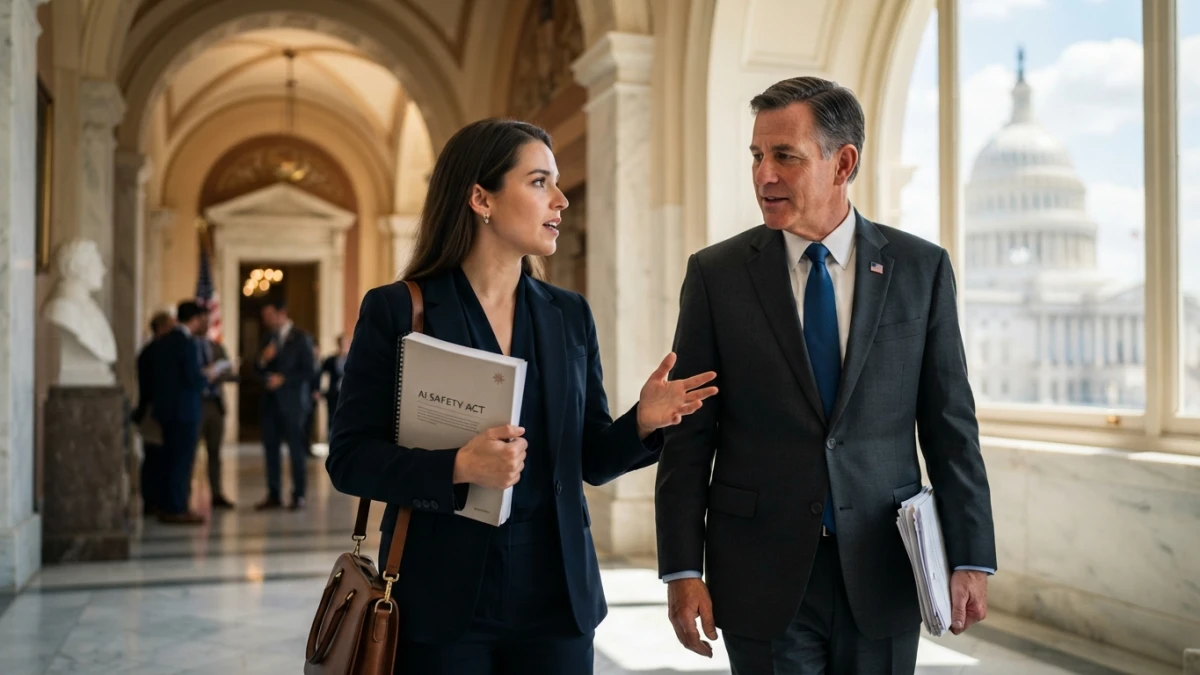
Anthropic is privately shopping a draft AI safety bill to lawmakers in Washington —one that forces outside audits of frontier models while limiting when the government can stop one. It is not a filed bill: it is a text in circulation.
What We Know About Anthropic's AI Safety Bill Draft
Politico reported on October 16, 2026 that Anthropic has been pitching Capitol Hill lawmakers a draft federal bill on frontier AI safety and security. The report rests on three people with direct knowledge of the effort and on a copy of the text, which is not public. Reuters picked it up the same day.
Three points recur in the coverage: new obligations for frontier developers, limits on the circumstances in which the government could block the release of an advanced model, and preemption of some state AI safety laws.
A bill has a number, a sponsor and a committee; this is a draft handed around for conversation that could change entirely before existing, or never exist at all. What is a fact is that the company wrote it and put it in front of lawmakers. Anthropic says it reflects what it published on June 10, 2026 in its Advanced AI Framework: binding obligations on frontier developers, catastrophic-risk testing of the most capable models, independent external evaluators, public summaries of results, and accountability to an authority with real power. That framework already conceded that voluntary transparency is not enough.
Read also


What the Text Asks For, Piece by Piece
Independent Evaluators on a Recurring Schedule
Outside review of developers and their most advanced models on a recurring basis, not once before launch. It follows the logic of a financial audit and is the piece with the most industry consensus; it is also the most expensive, and that favors whoever already has scale.
The Procedure to Suspend a Model
The text sets conditions for the government to stop a deployment. According to Interesting Engineering's analysis, the threshold being discussed is estimated damages above $1 billion: below that, the federal authority would have no grounds to act. That is the double move: it creates an intervention power that does not explicitly exist today, but ties it to a very high bar and a defined procedure.
Incident Reporting
An obligation to report incidents to the authority. Without a record of what fails, there is no way to judge whether the rules work. The company itself has already published a report on unexpected model behavior during its own evaluations, and that episode is the strongest argument for making reporting mandatory.
Read also

The Bar: When Government Could Step In
One billion dollars in damages is an enormous number: more than most consumer AI startups used to bill in a month. A threshold like that does not prevent regulation, but it leaves almost everything that happens in the day-to-day of a product outside the frame.
A High Bar Is Also a Way of Not Regulating
That is the critics' reading, and it should be presented as a reading. A rule with an extremely high trigger almost never fires: the simple analogy is an alarm that only goes off once the house has burned down. Defenders answer that a low threshold would turn the regulator into a political bottleneck. The categories mentioned —biosecurity, cyberattack and loss of control— are the classic catastrophic-risk ones, and none is an everyday harm: the text aims at the extreme and leaves the rest to general consumer, privacy and liability rules.
The Uncomfortable Part: State Laws
Preemption is the mechanism by which federal law displaces state law in an area: if Congress legislates, the state cannot enforce its own rule there. The draft would preempt parts of state AI safety laws, not all of them.
The Patchwork Being Trimmed
States currently run different rules on audits, risk assessment and minors. Unifying has a real upside for builders: one rule, one process. And a real cost for anyone living in the state that passed the strictest rule: that protection gets weaker.
Big companies win, because they can absorb a single compliance regime and negotiate with one authority. States that moved fastest lose. And there is a third effect: if the federal standard is born from a text written by a regulated party, the bar lands where that party can live with it. That does not prove bad faith, but it explains why the regulatory capture critique appears in nearly every piece of coverage.
Why Now: The Company That Wants to List
According to reporting by The New York Times on October 14, Anthropic told investors it booked $16.8 billion in third-quarter revenue, 45% more than the $11.6 billion in the previous quarter, and said it was profitable on an adjusted basis. The valuation under discussion is around $2 trillion, with trading possibly starting in the coming months. A company about to list prefers one known framework over fifty that can change: that is context, not proof of intent.
The Industry's Other Voice
In an interview with Politico published on October 4, Sam Altman said the world should accept some bad things happening in exchange for the benefits of AI, and drew a line between his position and Anthropic's on regulation. There is no single industry view. OpenAI has also published its disclosure framework for cases of model misalignment: each lab pushes its own standard while arguing about its neighbor's.
What Changes If You Build on Frontier Models
If You Consume APIs: Obligations That Arrive by Contract
The rules reach you anyway, through another channel: the provider's terms. Version change notices, acceptable use, per-use-case limits and incident reporting up the chain. Your ability to switch providers becomes part of your architecture.
If You Fine-Tune or Self-Host: The Compute Threshold
The June framework defined who the obligations apply to using compute and revenue criteria. For most small teams the answer is no, and that is good news: the heavy obligations stay at the top. The risk is that the threshold moves down over time.
If You Sell to the Public Sector: Outside Audit as a Buying Requirement
In public sector and healthcare sales, external audit stops being a future rule and becomes a purchasing requirement. Tenders already ask for risk assessment documentation, and none of that depends on this draft becoming law.
Conclusion
That the regulated party is drafting the rule is part of the story, not an awkward detail to skip. Anthropic put in writing what it wants Congress to debate, with two moves in the same text: more obligations for everyone and less room for the regulator to act. Watch whether another company puts forward its own text, whether any lawmaker adopts it, and what the states whose rules would be trimmed have to say. What already affects you is not the law: it is the contracts and the tenders. We will keep following this file on this blog.