NVIDIA DSX POD: An AI Factory in a Shipping Container, Live in 14 Days

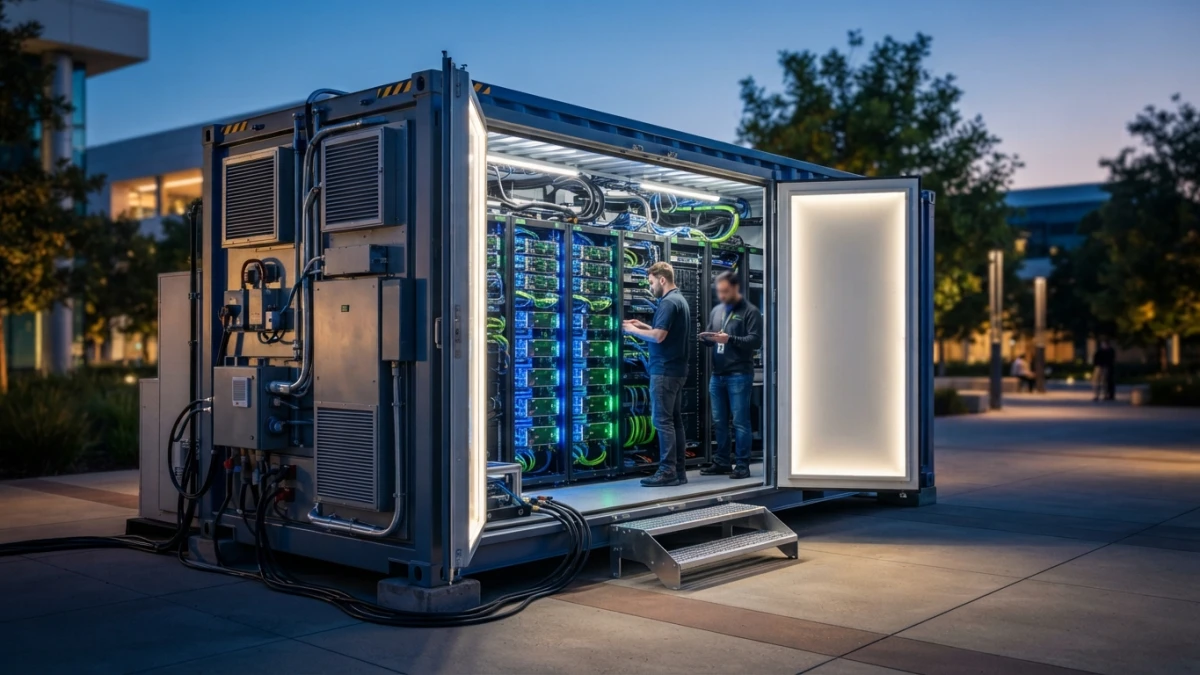
NVIDIA unveiled the NVIDIA DSX POD at GTC Berlin: seven Vera Rubin racks inside a container you move by truck and that, according to the company, starts serving tokens in 14 days instead of six months.
What the NVIDIA DSX POD Is, in One Sentence and in Detail
The short definition is NVIDIA's own: a reference architecture for standing up a complete AI factory on Vera Rubin silicon inside modular containers, tested before it leaves the factory. The long one is what matters, because that is where the concrete numbers live.
Seven Vera Rubin NVL72 Racks Inside a Container
A POD is seven liquid-cooled compute racks, all Vera Rubin NVL72. Each rack packs 72 Rubin GPUs and 36 Vera CPUs tied together by a copper NVLink backbone, behaving as one very large GPU.
Factory-Integrated and Factory-Tested: What That Means
Cabling and the cooling loop are assembled and validated before delivery, not at the customer's site. That turns deployment into a commissioning job instead of a months-long assembly project.
The 17 Kilometers of Spectrum-X Cabling and the Liquid Cooling
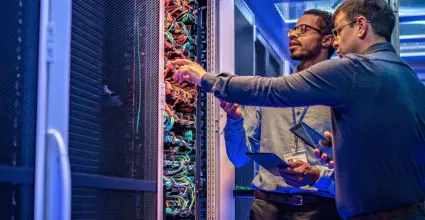
Roughly 17 kilometers of Spectrum-X cabling run between the racks, using NVIDIA's network fabric for these installations. That number conveys the scale: this is not a big server, it is a compute block with its own network and cooling and power draw measured in hundreds of kilowatts.
What an NVIDIA POD Is and What It Is Not
A Reference Architecture, Not a Product You Buy Off a Shelf
A reference design means NVIDIA specifies how the system is built and partners build it. There is no order code and no public price: there is a blueprint, a set of integrators and a delivery date.
DSX POD Is Not the Vera Rubin POD: Do Not Mix the Two Names
Vera Rubin POD is the reference system with several rack types; DSX POD is the container-packaged version meant for deploying AI factories. They share silicon and sound alike, but they are not the same thing.
The Partners Who Will Build It and Deliveries Starting in 2027
Dell Technologies, Foxconn, Crusoe, Bull, Armada and Anduril are among the partners taking it to customers, with deliveries from early 2027. Until then, everything you read about the POD is a plan, not a running installation.
The Fine Print Behind the 14 Days
The "Once the Site Has Power, Cooling and Network" Clause
The 14-day figure comes with a condition, and that condition is the real story: the clock starts when the site already has a grid connection, cooling and connectivity. That work still happens outside the container and usually takes months.
Permits, Grid Connections and Water: What Does Not Travel in the Container
It helps to separate what arrives inside from what does not:
- Inside: integrated racks, network cabling, installed liquid cooling and factory testing.
- Outside: construction permits, the power connection, water or a closed loop, fiber and on-site staff.
Hundreds-of-Kilowatts Racks in Buildings Designed for Something Else
Seven high-density liquid-cooled racks demand electrical and thermal infrastructure that plenty of existing data centers do not have: the bottleneck moved from the rack to the site.
Why Containers: The Race for Time to First Token
From Months to Weeks of "Time to Token", per NVIDIA
The commercial argument is time to first token: when the investment starts producing. Going from six months to two weeks changes the payback and, more importantly, who can afford a deployment.
Water and Energy Efficiency: What the Company Claims and What Still Needs Measuring
NVIDIA argues its architecture makes data centers more efficient in both water and energy. That is a company claim, not an independent measurement: no third-party audited figures exist yet. The same goes for per-rack performance gains over the previous generation, which come from inference project documentation rather than a neutral benchmark.
DSX MaxLPS and DSX Flex: The Problem of Available Power
Alongside the POD, NVIDIA reinforced two pieces of its stack aimed at the shortage of available power at sites. That is the useful admission in the announcement: the problem is not buying GPUs, it is finding somewhere to plug them in.
Why It Was Announced in Berlin
Europe Wants AI Capacity Without Depending on Someone Else's Cloud Region
The announcement frames the POD as a way to speed up AI infrastructure deployment in Europe, where capacity has lagged demand. Bull, one of the partners, is French: it is not only unveiled on the continent, it is also assembled there.
Data Sovereignty in Practice: What It Means to Have the Racks in Your Country
For a company with data residency obligations, keeping the racks in its own country simplifies compliance and reduces reliance on a foreign provider. It does not solve everything, but it changes the conversation with legal.
What This Means If You Build Software
More Capacity, Sooner, Usually Moves Inference Pricing
If capacity gets deployed in weeks rather than quarters, supply grows faster. Historically that pushes inference prices down. It is not a promise or a date: it is a trend to track once the first operators go live.
On-Prem Models: When They Start Beating an API Bill
If your API bill exceeds the cost of running your own hardware and your load is steady, on-prem models start to compete. Today that comparison is made against single servers; with seven-rack blocks the threshold rises, but deployment time shrinks.
What Does Not Change Yet: There Is No POD to Rent Today
None of this touches your next sprint: there is no POD to point an API key at, and first deliveries are in 2027. If you care about where the hardware is heading, what NVIDIA is as a company and its role in AI infrastructure supply the context this announcement takes for granted.
Conclusion
The container solves assembly, not the permit or the plug. In 2027 there are three things to watch: whether the timelines hold, what capacity is priced at and whether existing data centers can take racks of this density. If you want to follow the AI industry with numbers and without hype, the blog has more analysis of hardware, chips and infrastructure.