Nvidia and TCV Back Higgsfield: AI Video Now Gets Infrastructure Money

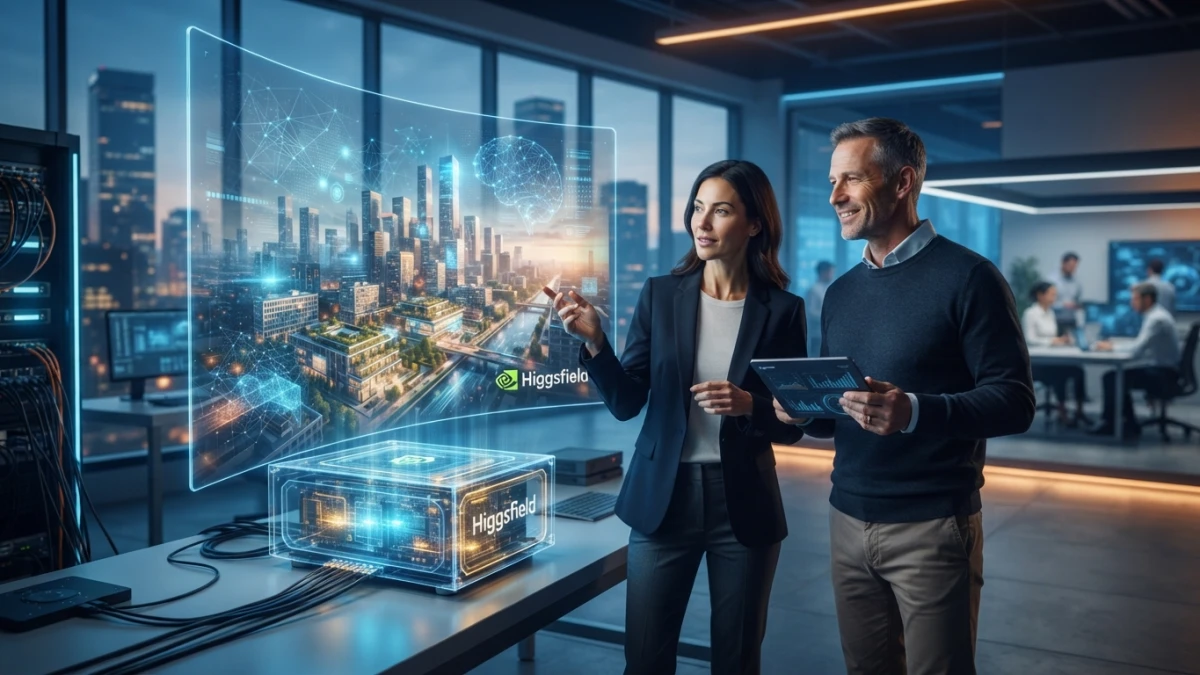
Nvidia and TCV have just put money into Higgsfield, the AI video platform valued at $5.4 billion in August. The deal brings no figures, but it says plenty about where the money is going.
What Was Announced on October 23
Higgsfield reported an extension of its Series B round with new investment from TCV and Nvidia. The announcement came from San Francisco and Astana and is signed by the company itself, not Nvidia: worth keeping in mind before reading the headlines.
A Series B Extension, With No Public Amount
Bloomberg and the company's own post agree on what matters and on what is missing: both funds invested and no amount was disclosed. Any figure floating around is a third-party estimate.
What the Money Is For: Product, Infrastructure and Hiring
According to Higgsfield, the capital goes to product development, global infrastructure, hiring and go-to-market expansion. Translated: more compute to meet demand, not a stake bought in another company.
Read also

Who Higgsfield Is
It is an AI-native creative suite for generating image, video and voice, with a public API billed per generation. It sells itself as a full production studio inside one interface, not as a standalone generator.
From AI Factory, Bought by Snap, to an AI-Native Creative Suite
It was founded by Alex Mashrabov, a former Snap executive, together with AI engineer Yerzat Dulat and Mahi De Silva. Mashrabov had previously created AI Factory, the computer vision company behind Snapchat's filters and Cameos, which Snap ended up acquiring. The company describes itself as Kazakhstan's first AI unicorn.
Kazakhstan: Where the Engineering Is and Why Jensen Huang Showed Up
The headquarters are in San Francisco and the technical roots are in Kazakhstan, with Astana Hub as a partner. The announcement coincided with Jensen Huang's first visit to the country, during its national AI Month. That is no small coincidence: the investment and the tour read together.

The Numbers Behind the Round
$400 Million in August at a $5.4 Billion Valuation
The base Series B was $400 million in August, led by DST Global, with Goldman Sachs Alternatives, Tribe Capital, AI Capital Partners, Smash Capital, GFT Ventures and Valor Capital. The October extension published no new valuation: the $5.4 billion figure is from August.
What "$1 Billion Run Rate" Means and What It Does Not
The company says it crossed $1 billion in annualized run rate in September, 18 months after launch, and explains its method: it takes revenue from the last four weeks and multiplies it by 13. That is not trailing twelve-month revenue and it is not profit. It is a projection, and one exceptional month inflates it on its own. In the same post it reports more than 40 million users across 238 countries and contracted business revenue up tenfold since June.
What Changes for People Who Make 3D and Video
Previs, Variants and Cost Per Shot
The useful reading is not "another tool" but where the money comes from: the demand funding this round comes from advertising and catalog work, where teams produce dozens of variants per concept and measure return. For a studio, that pushes the tool toward previsualization and concept testing — that is, toward cost per shot before anything gets filmed.
What Generative Video Still Does Not Solve
Character consistency across shots, fine camera control and fitting into a versioned pipeline still need 3D and post-production. Anyone who has compared generative image models knows the pattern: quality per piece climbs fast, consistency across pieces is a different fight, as the comparison between Seedream 4.0 and Nano Banana shows, and as natively multimodal models keep advancing. If you come from classic 3D, what Stable Diffusion is and how to use it is still the best way in.
What We Do Not Know
No amount, no post-October valuation, no profitability figures. It is also unclear what stake the new investors take or whether Nvidia has any supply commitment. And the analysis part has to be labelled as such: funding whoever generates video at scale is funding compute demand, but that is this blog's reading, not an Nvidia statement.
Conclusion
The money is no longer chasing awe, it is chasing the infrastructure of whoever produces content at industrial pace. For anyone modelling or editing, the practical question has changed: not whether AI can generate a good-looking shot, but what the fiftieth shot of the same campaign costs. On that, the run rate, the valuation and the round explain far less than the invoice on your next project.